

The British rule in India was one of the most important phases in modern Indian history. It transformed India’s political administration, economy, society, education, transport and legal institutions, while also generating resistance that eventually developed into a nationwide freedom movement. The history of the British Raj in India is not limited to the period after 1858; British expansion began much earlier through the East India Company and gradually changed from commercial activity into territorial and political control.
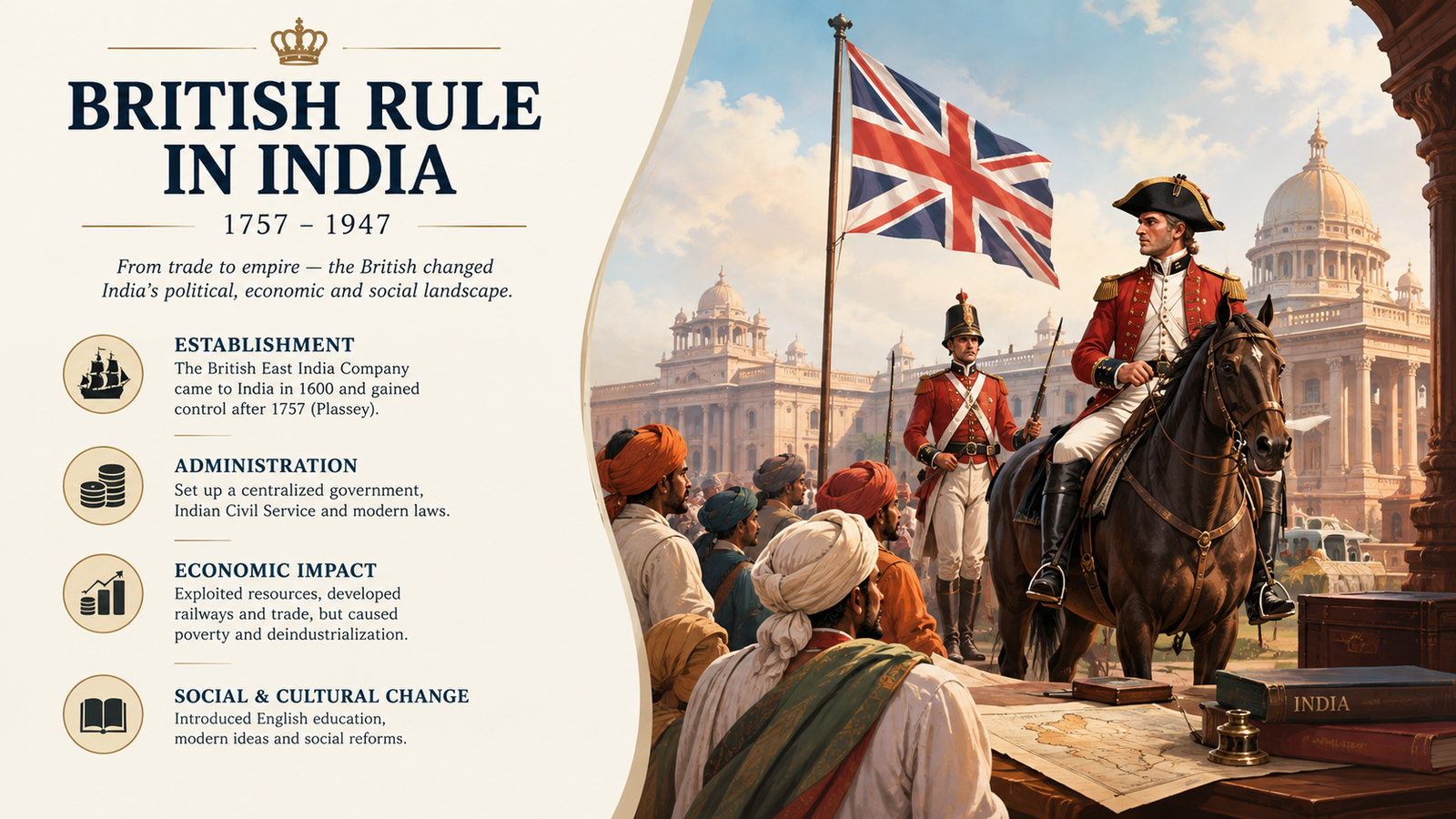
Understanding the colonization of India therefore requires looking at several stages—from the arrival and expansion of the East India Company to the establishment of Crown rule in 1858 and finally India’s independence in 1947.
Rise of the East India Company in India
The story of the British rule in India began with the English East India Company, which initially came to the subcontinent primarily for trade. Over time, the Company became increasingly involved in Indian politics and military affairs.
The Battle of Plassey in 1757 was a major turning point. Company influence expanded significantly in Bengal, and after the Battle of Buxar in 1764, the Company gained an even stronger political and financial position. The Company used political agents called Residents, military power, diplomacy and arrangements such as subsidiary alliances to expand its influence over Indian states.
This gradual expansion was central to the colonization of India. Rather than conquering every territory through direct warfare, the Company frequently combined military action with political agreements, economic pressure and intervention in the affairs of Indian rulers.
Expansion of British Control
During the late 18th and early 19th centuries, Company authority expanded across large parts of the Indian subcontinent. Different policies were used to increase British influence.
The subsidiary alliance system associated with Lord Wellesley required participating Indian rulers to accept British military protection and maintain British troops in their territories. Later, Lord Dalhousie’s policy of annexation, including the Doctrine of Lapse, further expanded Company-controlled territories.
By 1856, following the annexation of Oudh, much of the Indian subcontinent was under direct Company rule or associated with the Company through allied rulers.
These developments made the colonization of India a political as well as an economic process.
Economic Impact of British Rule
The economic consequences of the British Raj in India are an important subject of historical study. Under Company rule, revenue collected from Indian territories became closely connected with the Company’s commercial interests.
Revenues generated from territories under British control were used to purchase Indian raw materials and goods, while the structure of trade increasingly moved toward exporting raw materials and importing manufactured goods.
Indian textiles had previously been important in international trade, but British industrialisation and changing trade policies altered the competitive environment. Agriculture also became increasingly connected to commercial production and revenue requirements in different regions.
The economic history of the colonization of India is complex, and historians have debated the scale and causes of changes in Indian income, industry and living standards. Therefore, individual economic effects should be studied through specific evidence rather than a single explanation.
The Revolt of 1857
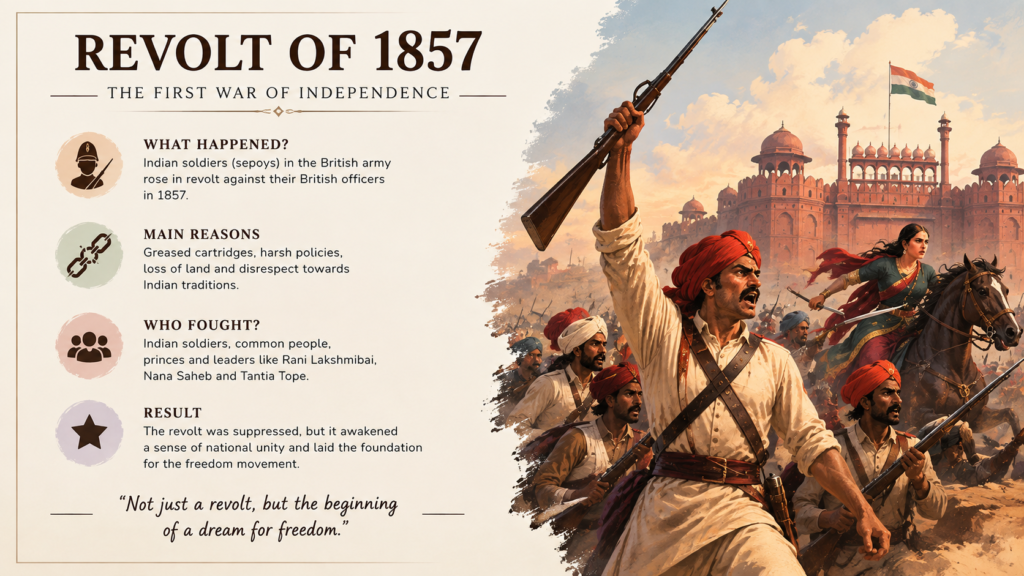
The Revolt of 1857 marked a major turning point in the British rule in India. It began among Indian soldiers of the East India Company’s army and developed into a wider uprising involving different groups and regions.
Issues included military grievances, political annexations, economic pressures and concerns about religious and social interference. The uprising spread to important centres including Delhi, Kanpur, Lucknow and Jhansi.
The British eventually suppressed the revolt. The Government of India Act 1858 then ended the East India Company’s administrative authority and transferred control of its Indian territories to the British Crown.
This transition marked the formal beginning of the British Raj in India, meaning direct imperial rule by the British state.
Establishment of the British Raj
The British Raj in India lasted from 1858 until independence in 1947. The British monarch became the formal sovereign, while India was administered through the Secretary of State for India, the Viceroy and provincial governments.
The Government of the Raj was headed by the Viceroy and his appointed council. The Indian Councils Act of 1861 created an expanded legislative council, although Indian participation in governance remained limited.
The British administration also introduced and expanded systems of railways, telegraph communication, modern postal networks, courts and formal bureaucratic institutions. These developments changed India’s infrastructure and administrative geography, although they were also connected to the requirements of colonial administration, military movement and trade.
Education became another important part of the colonization of India. British-era educational institutions helped spread English-language education and introduced new forms of administration, law and modern professional training.
Indian intellectuals also used these new educational networks to debate social reform, political rights and nationalism. Universities established in the 19th century produced generations of lawyers, teachers, journalists and political leaders.
At the same time, Indian reformers played a major role in social and religious reform movements. Figures such as Raja Rammohan Roy, Swami Dayanand Saraswati, Sir Syed Ahmad Khan and others contributed to different intellectual and social movements.
Rise of Indian Nationalism
The later phase of the British rule in India witnessed the growth of organised political nationalism. The Indian National Congress was founded in 1885, and political participation gradually expanded.
The Indian Councils Acts of 1892 and 1909 increased the number of Indians participating in legislative councils, although these institutions remained limited in their powers.
The early 20th century saw increasingly diverse forms of political activity, including constitutional politics, revolutionary movements, mass mobilisation and campaigns for self-government.
Gandhian Movements and the Freedom Struggle
The British Raj in India faced increasingly large-scale political mobilisation after the First World War. Mahatma Gandhi became a central figure in mass movements such as the Non-Cooperation Movement, Civil Disobedience Movement and Quit India Movement.
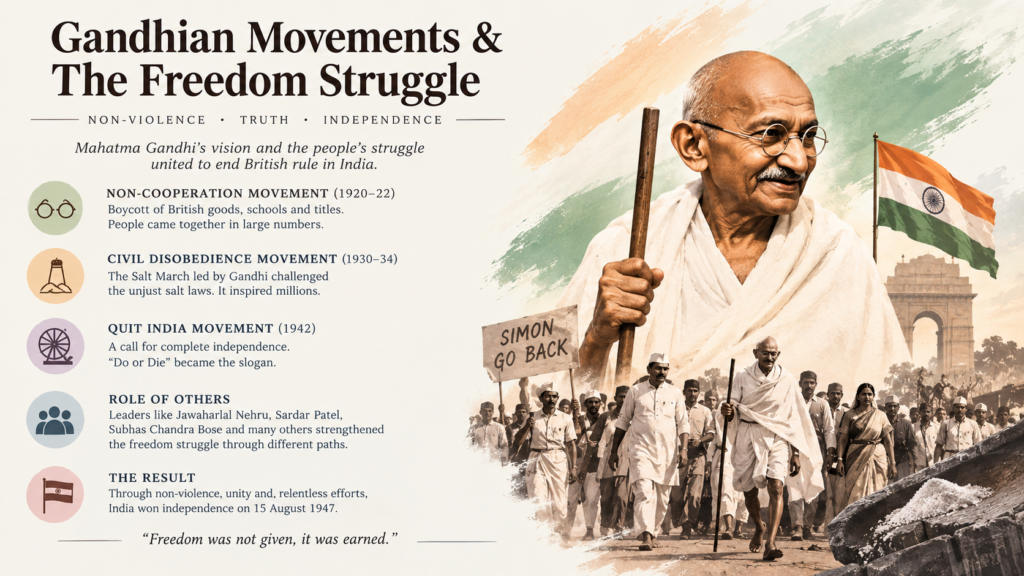
Other leaders, organisations and movements also played important roles in the freedom struggle. The movement involved people from different regions and social backgrounds, although political strategies and visions for India’s future differed considerably.
The Government of India Act 1935 introduced provincial autonomy and expanded elected representation. In 1937, Congress ministries were formed in seven of the eleven provinces.
End of British Rule in India
The Second World War accelerated political and constitutional changes. After the war, negotiations over India’s future intensified among British authorities and major Indian political organisations.
The British Parliament passed the Indian Independence Act in July 1947. India became independent on 15 August 1947, bringing the period of the British Raj in India to an end.
Independence was accompanied by the Partition of British India and the creation of India and Pakistan. The transition involved enormous population movements and widespread violence, making 1947 one of the most consequential turning points in South Asian history.
Legacy of British Rule
The legacy of the British rule in India can be studied through several dimensions. Colonial administration influenced India’s legal and bureaucratic systems, infrastructure, education and political institutions. At the same time, colonial economic policies, political inequalities and resource extraction became major subjects of criticism among Indian nationalists and later historians.
Today, researchers continue to examine this period through official records, newspapers, private correspondence, archaeological evidence, economic data and personal accounts. Institutions such as the Archaeological Survey of India continue to research, preserve and document India’s historical heritage, including epigraphy, archaeology and conservation.
Conclusion
The history of the colonization of India was a long process rather than a single event. The East India Company gradually moved from commercial activity toward political authority, expanding its influence through warfare, diplomacy, alliances and administrative control.
The Revolt of 1857 ended Company rule and established the British Raj in India under the Crown. During the following decades, colonial administration transformed many aspects of Indian society and economy while simultaneously encouraging the development of political organisations and nationalist movements.
Finally, after decades of political struggle and negotiations, India achieved independence on 15 August 1947. Studying the British rule in India through multiple sources helps explain both the structures created during colonial rule and the diverse movements that challenged them.