

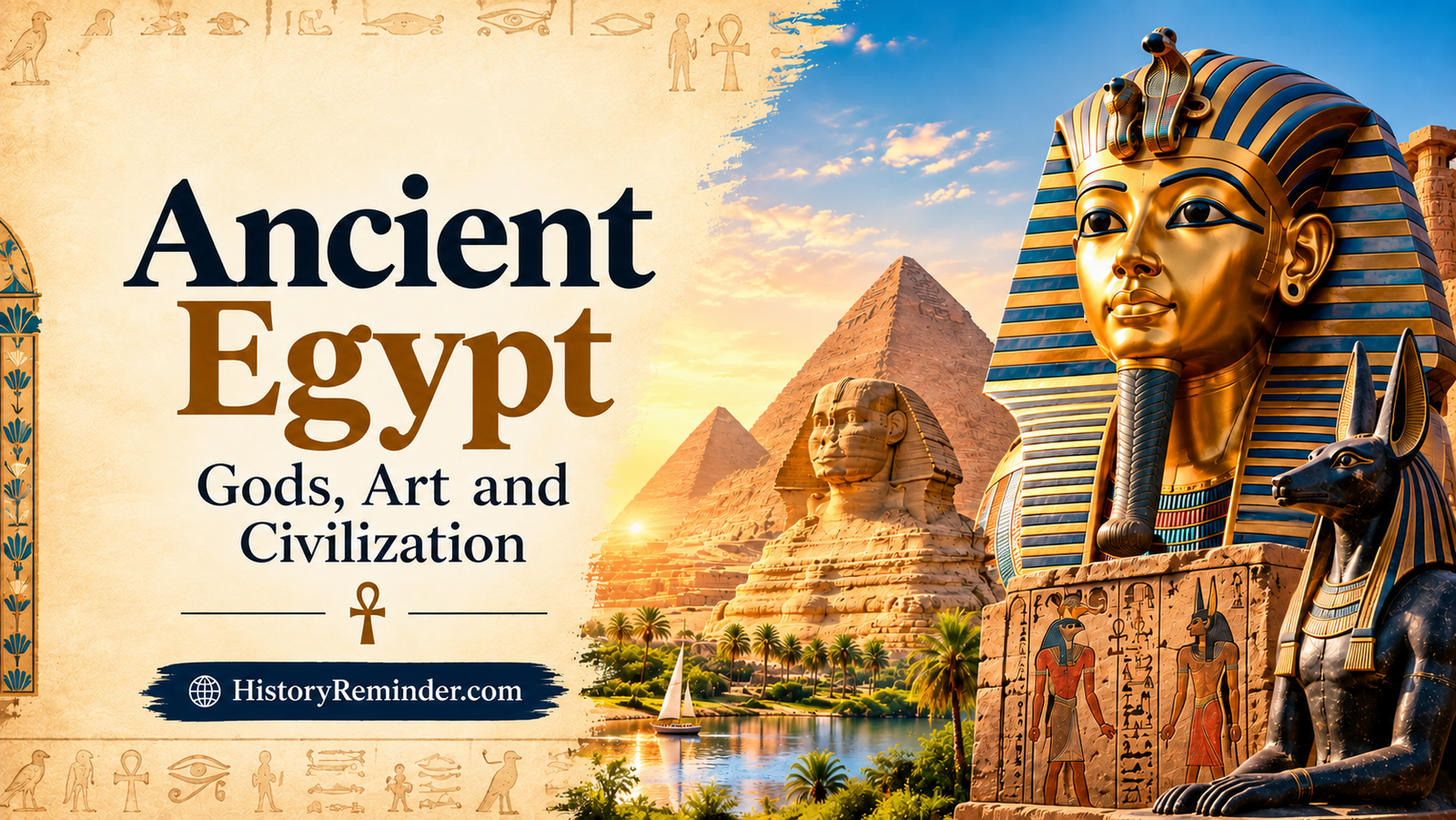
 Religion was deeply connected with Egyptian society. The ancient Egyptian gods were associated with the natural world, kingship, fertility, death, protection and the afterlife. At the same time, ancient Egyptian art served religious, political and funerary purposes and provides historians with important evidence about how Egyptians represented people, rulers and divine beings.
The Rise of Ancient Egyptian Civilization
Ancient Egyptian civilization developed around the Nile, whose annual flooding supported agriculture and settlements. The river also provided an important transportation route connecting communities along Upper and Lower Egypt.
Political unification traditionally associated with the beginning of dynastic Egypt is generally placed around the late 4th millennium BCE. Egyptian chronology, however, is not completely fixed. Dates for earlier periods can differ among scholars because surviving king lists are incomplete and some rulers or overlapping dynasties are difficult to place precisely.
The pharaoh became the central political figure, while temples and religious institutions played major roles in economic and social life.
Major Periods of Ancient Egypt
Egyptian history is commonly divided into several broad periods:
- Early Dynastic Period: Formation and consolidation of the Egyptian state.
- Old Kingdom: Associated with the construction of the great pyramid complexes.
- First Intermediate Period: Political fragmentation and regional power.
- Middle Kingdom: Reunification and renewed political and cultural development.
- Second Intermediate Period: Period of political division and Hyksos rule in parts of Egypt.
- New Kingdom: A period of imperial expansion and major monumental construction.
- Third Intermediate and Late Periods: Increasing political changes and foreign influence.
- Ptolemaic Period: Greek-Macedonian rulers governed Egypt after Alexander the Great.
- Roman Period: Egypt became part of the Roman Empire.
The New Kingdom, approximately 1550–1069 BCE, was particularly important. Egypt became a major power in the ancient Near East, while famous monuments were constructed or expanded during this period.
Ancient Egyptian Gods and Religious Beliefs
The ancient Egyptian gods formed a diverse religious tradition rather than a single uniform system. Different cities and regions sometimes emphasized different deities, and the importance of particular gods changed over time.
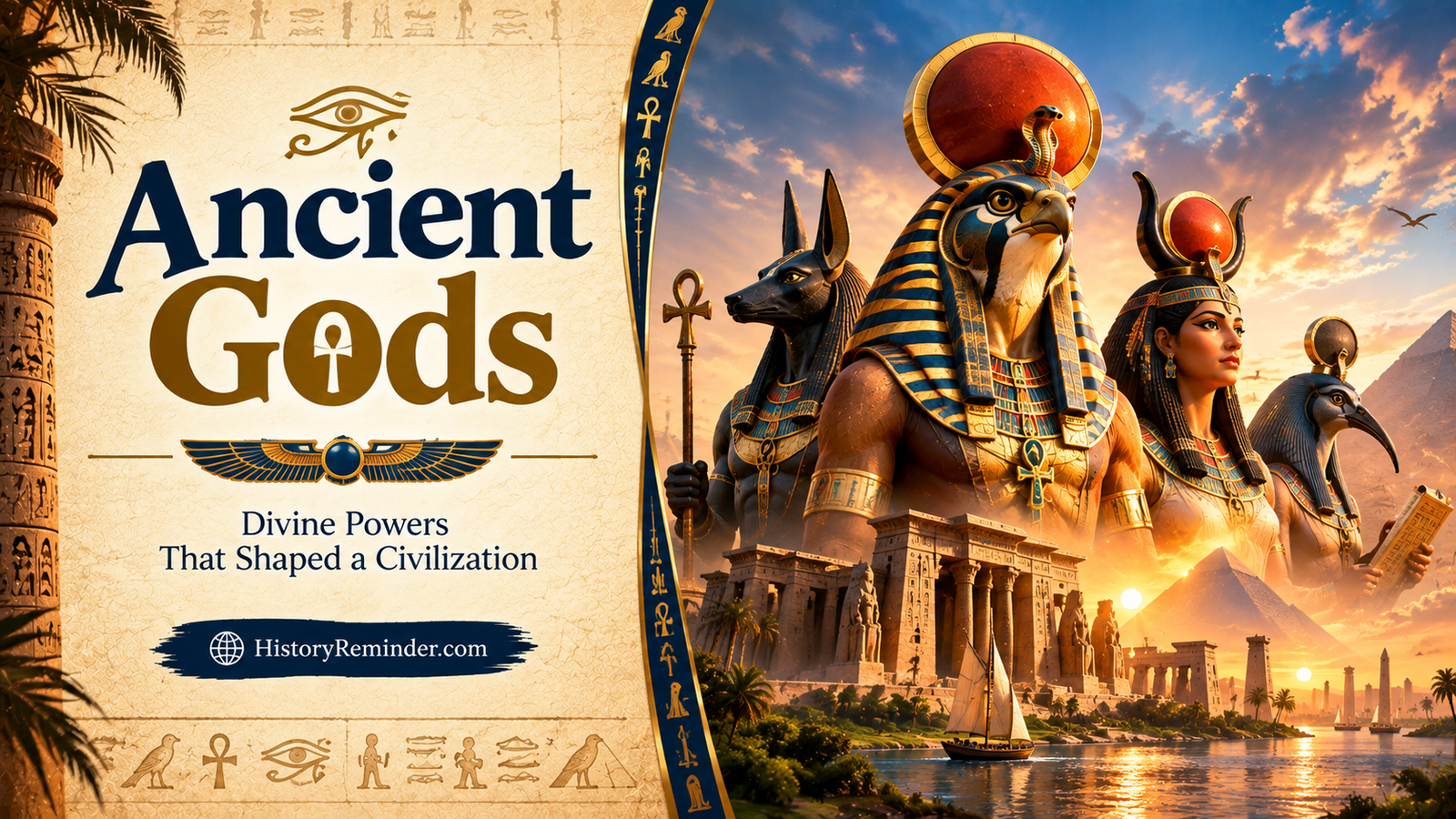
Among the best-known ancient Egyptian gods was Osiris, who was strongly associated with death and the afterlife. Osiris became an important funerary deity and was widely represented in Egyptian religious art.
Isis was associated with protection and motherhood, while Horus was connected with kingship and the sky. Anubis was associated with embalming and the dead, and Thoth was connected with writing and knowledge.
Other important ancient Egyptian gods included Amun, Ra, Ptah, Hathor, Bastet and Sekhmet. Their roles could change depending on the period and religious centre.
Amun became particularly prominent during the New Kingdom and was closely associated with the temple complex at Karnak in Thebes. The diversity of the ancient Egyptian gods reflects the changing religious landscape of Egypt over thousands of years. Gods could also be combined or associated with one another, creating new forms of worship and religious symbolism.
Temples and Worship
Temples were central to ancient Egyptian religious life. They were not simply places where people gathered for modern-style worship; they were institutions connected with rituals, offerings, administration, storage and economic activity.
Karnak is one of the most famous temple complexes associated with ancient Egypt. During the New Kingdom, resources from Egypt’s growing power supported extensive building projects, particularly at Karnak.
The relationship between temples, rulers and the ancient Egyptian gods can be seen in inscriptions, statues and reliefs. Pharaohs were frequently represented making offerings to deities, reinforcing the connection between kingship and divine order.
Ancient Egyptian Art
The term ancient Egyptian art covers a remarkably wide range of objects and visual traditions, including sculpture, painting, reliefs, jewellery, coffins, papyri and architectural decoration.
One of the most recognizable characteristics of ancient Egyptian art is its highly organized visual language. Human figures were often represented according to established conventions. Important individuals could be shown larger than other figures, while rulers and gods were represented with distinctive crowns, clothing and symbols.
Egyptian artists also used colour, gesture and objects to communicate identity and status. These conventions allowed images to convey information even when the viewer could not read hieroglyphic inscriptions.
Ancient Egyptian Art and the Afterlife
A major part of ancient Egyptian art was connected with funerary beliefs. Tomb paintings, coffins, statues, amulets and funerary papyri were created to support the deceased in the afterlife.
The famous Book of the Dead contained religious texts and spells intended to help the deceased navigate the afterlife. Archaeological discoveries continue to reveal new examples of funerary objects and religious imagery.
At Saqqara, Egyptian archaeologists have discovered large numbers of coffins, mummies and bronze statues representing ancient Egyptian gods including Anubis, Amun, Min, Osiris, Isis, Nefertum, Bastet and Hathor.
Such discoveries demonstrate how closely religion, burial practices and artistic production were connected.
Pyramids and Monumental Architecture
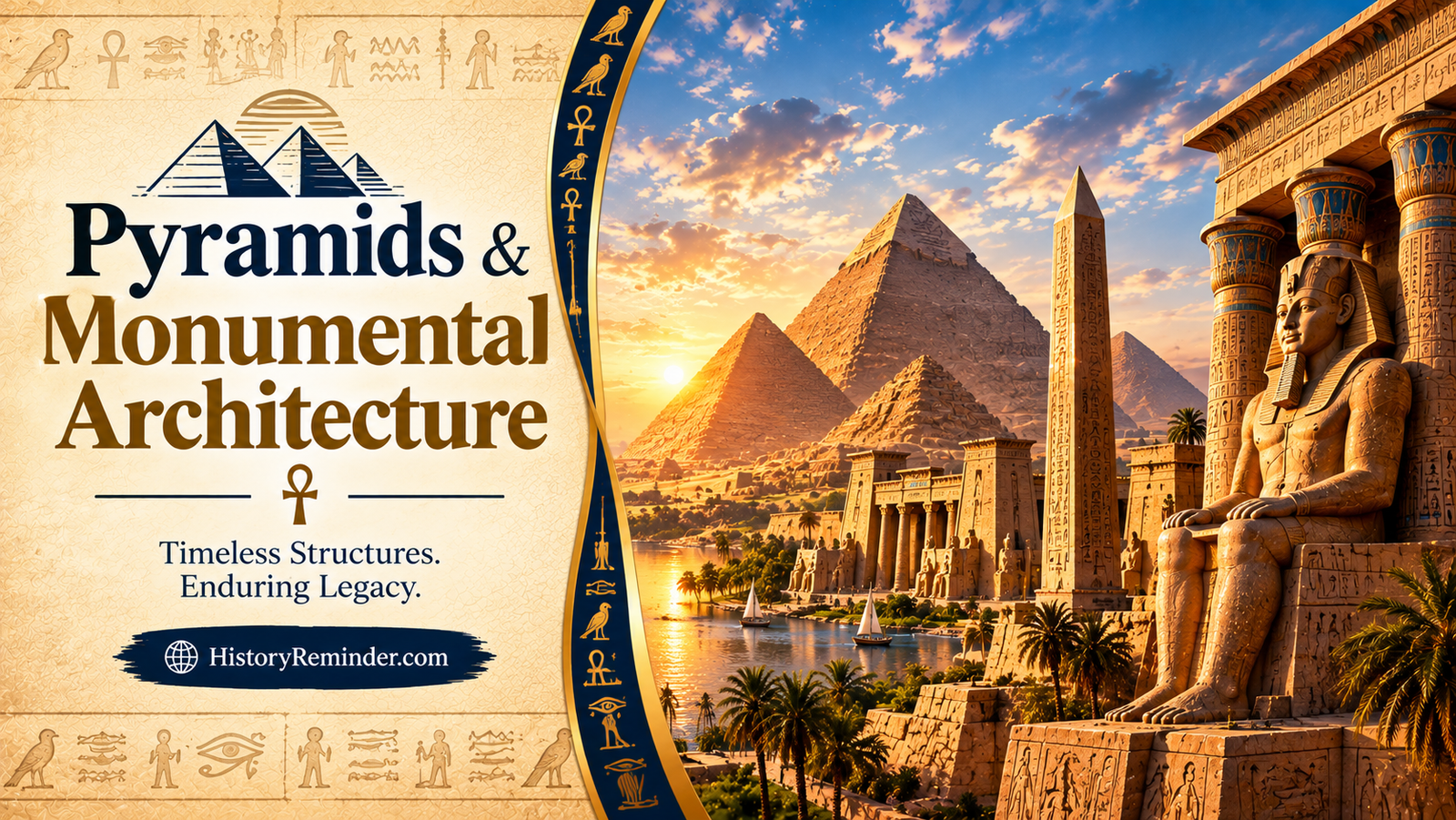
The pyramids remain among the most recognizable achievements of ancient Egypt. The pyramid complexes of the Old Kingdom demonstrate the organizational capacity of the Egyptian state and the technical knowledge available to its builders.
The Great Pyramid at Giza was built for Pharaoh Khufu. Other major monuments at Giza include the pyramids associated with Khafre and Menkaure and the Great Sphinx.
Egyptian monumental architecture continued long after the pyramid-building era. Temples, obelisks, tombs and statues were constructed throughout the Nile Valley.
The New Kingdom was particularly rich in monumental architecture. The Valley of the Kings became the burial place of many rulers, while major temples were built at Karnak, Luxor and elsewhere.
Writing, Knowledge and Everyday Life
The ancient Egyptians developed hieroglyphic writing and other writing systems used for religious, administrative and everyday purposes. Scribes played an important role because writing was essential for administration, taxation, religious institutions and record keeping.
Papyrus provided an important writing material. Surviving texts allow historians to study religious beliefs, medicine, administration, literature and personal correspondence.
Ancient Egyptian knowledge also included mathematics, astronomy, medicine and engineering. The construction of large monuments required careful measurement, organization of labour and management of resources.
Recent Archaeological Discoveries
Ancient Egypt remains an active field of archaeological research. New excavations continue to provide evidence that can change or expand historians’ understanding of particular sites.
Recent Egyptian archaeological work has revealed new evidence at several important locations. At the Ramesseum in Luxor, excavations have uncovered tombs, workshops, storage areas, kitchens and bakeries, along with evidence of a “House of Life” associated with education at the temple.
At Abydos, archaeological research has also identified foundation deposits and storage facilities associated with the temple of Ramesses II, providing information about construction practices and the temple’s economy.
These discoveries show that the study of ancient Egypt is not simply about famous pyramids and mummies. Archaeologists continue to investigate ordinary buildings, workshops, storage areas, religious objects and burial sites.
The Continuing Legacy of Ancient Egypt
The influence of ancient Egypt can be seen in museums, archaeology, architecture, literature, popular culture and historical research around the world. Museums continue to preserve Egyptian statues, papyri, jewellery, coffins and other objects that help researchers understand the civilization.
The study of ancient Egyptian art is especially valuable because visual evidence survives from many different periods. Statues and reliefs provide information about religious practices, royal ideology, clothing, occupations and social organization.
Similarly, research into the ancient Egyptian gods helps historians understand how Egyptians interpreted nature, death, kingship and the universe.
Conclusion
Ancient Egypt was a complex civilization that developed over thousands of years along the Nile. Its political institutions, monumental architecture, writing systems, religious traditions and artistic conventions created a historical legacy that continues to be studied today.
The ancient Egyptian gods were central to religious life, while temples and funerary traditions connected religion with politics, art and society. At the same time, ancient Egyptian art created a distinctive visual language through sculpture, painting, reliefs and funerary objects.
Modern archaeological discoveries continue to add new evidence to this history. From Saqqara and Abydos to Luxor and the Valley of the Kings, excavations are still revealing details about the people, beliefs and institutions of ancient Egypt. Studying these discoveries alongside surviving texts and ancient Egyptian art allows us to develop a more detailed understanding of one of the world’s most enduring civilizations.