

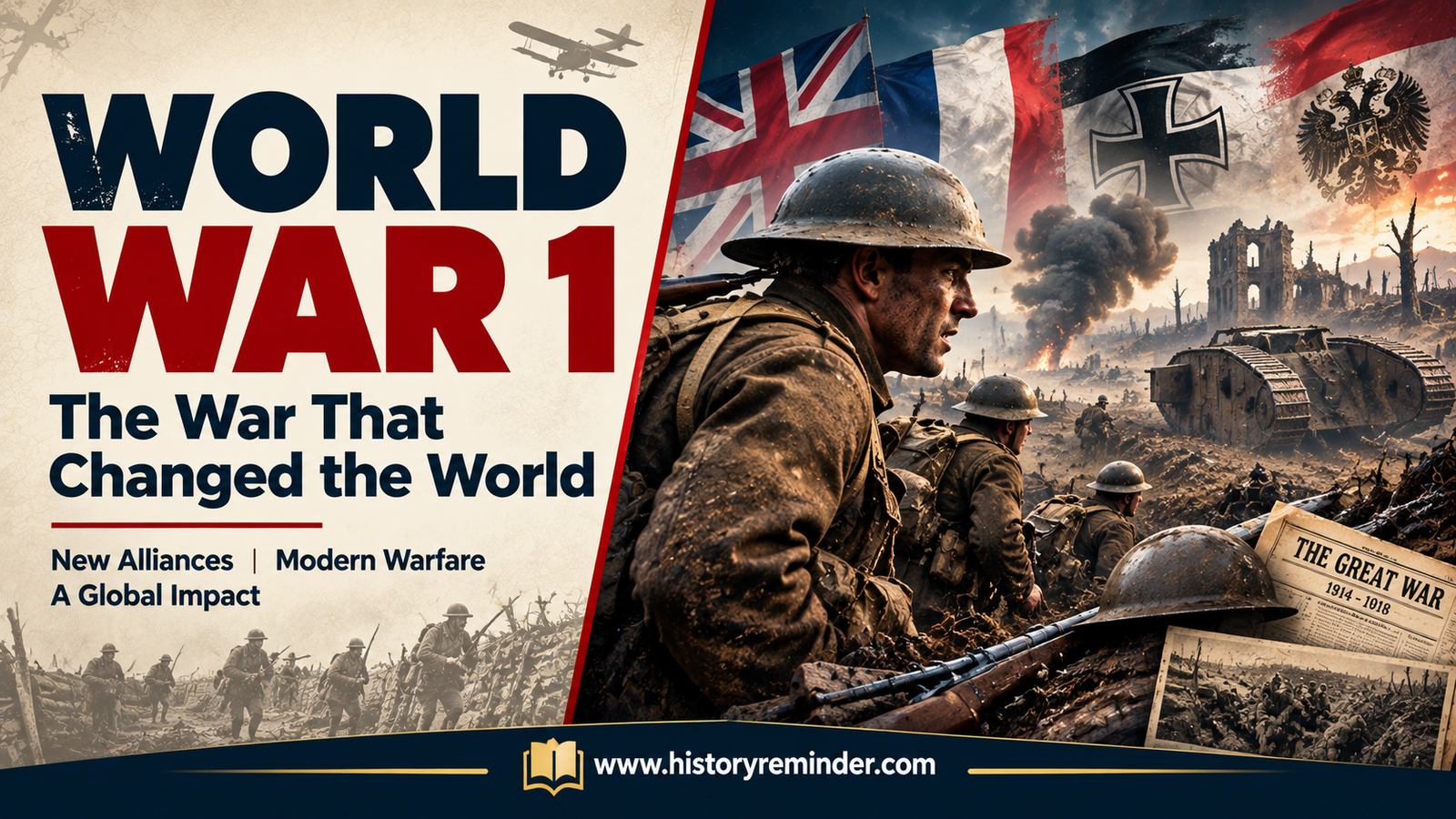
1. What Was World War 1?
World War 1, also known as the First World War or the Great War, was a global conflict fought mainly between two opposing groups: the Allied Powers and the Central Powers. The war began in 1914 and continued until the armistice of 11 November 1918.
The Allied Powers included France, Britain, Russia, and later the United States, along with several other countries. The Central Powers included Germany, Austria-Hungary, the Ottoman Empire, and Bulgaria. Italy, despite being a member of the pre-war Triple Alliance, joined the Allied Powers in 1915.
The World War involved millions of soldiers and transformed the way countries organised their economies, industries, and armed forces. Governments directed factories toward military production, introduced new taxes and borrowing measures, and recruited large numbers of men into the armed forces. Women also took on important roles in factories, transport, agriculture, and medical services.
2. Major Causes of World War 1
The outbreak of World War 1 was not caused by a single event alone. Long-standing political rivalries, military competition, nationalism, imperialism, and alliance commitments created a tense international environment. The assassination of Archduke Franz Ferdinand became the immediate trigger for the conflict.
A. Nationalism
Nationalism was one of the major causes of the war. Across Europe, people expressed strong loyalty to their nations and demanded national recognition or independence. In the Balkans, nationalist movements challenged the control of Austria-Hungary and the Ottoman Empire.
Serbian nationalism was particularly important because Serbia supported the idea of uniting South Slavic peoples. Austria-Hungary viewed these ambitions as a threat to its authority. Nationalist tensions therefore increased distrust between European governments and made peaceful solutions more difficult.
B. Imperialism
Imperialism refers to the expansion of a country’s political, economic, and territorial influence over other regions. During the late nineteenth and early twentieth centuries, European powers competed for colonies, resources, markets, and strategic advantages.
Britain and France possessed extensive overseas empires, while Germany sought a greater role in global affairs. Competition over colonies and international influence increased tensions among the major powers. Although imperialism did not automatically lead to war, it contributed to the rivalries that shaped European diplomacy.
C. Militarism and the Arms Race
Militarism refers to the belief that military strength is essential for national security and international power. Before the war, several European countries increased military spending, expanded their armies, and developed modern weapons.
Britain and Germany competed in naval construction, particularly in the development of powerful battleships. Military planners also prepared detailed mobilisation plans, making governments more likely to act quickly during a crisis. Once mobilisation began, diplomatic negotiations became increasingly difficult.
D. Alliance System
European powers formed alliances to protect themselves against potential enemies. Germany and Austria-Hungary were closely associated, while France maintained an alliance with Russia. Britain reached agreements with France and Russia, creating a wider diplomatic alignment.
These relationships did not make a general war inevitable, but they increased the risk that a regional conflict would involve several major powers. During the July Crisis of 1914, military commitments, political calculations, and fears of strategic disadvantage helped turn a dispute in the Balkans into a wider European war.
E. Assassination of Archduke Franz Ferdinand
On 28 June 1914, Archduke Franz Ferdinand, heir to the Austro-Hungarian throne, and his wife Sophie were assassinated in Sarajevo by Gavrilo Princip, a Bosnian Serb nationalist. Austria-Hungary blamed Serbia for encouraging anti-Austrian nationalism and issued an ultimatum.
Austria-Hungary declared war on Serbia on 28 July 1914. Russia mobilised in support of Serbia, while Germany supported Austria-Hungary. Germany declared war on Russia and France, and its invasion of neutral Belgium brought Britain into the conflict. These developments transformed the assassination crisis into a major international war.
3. Major Events of World War 1
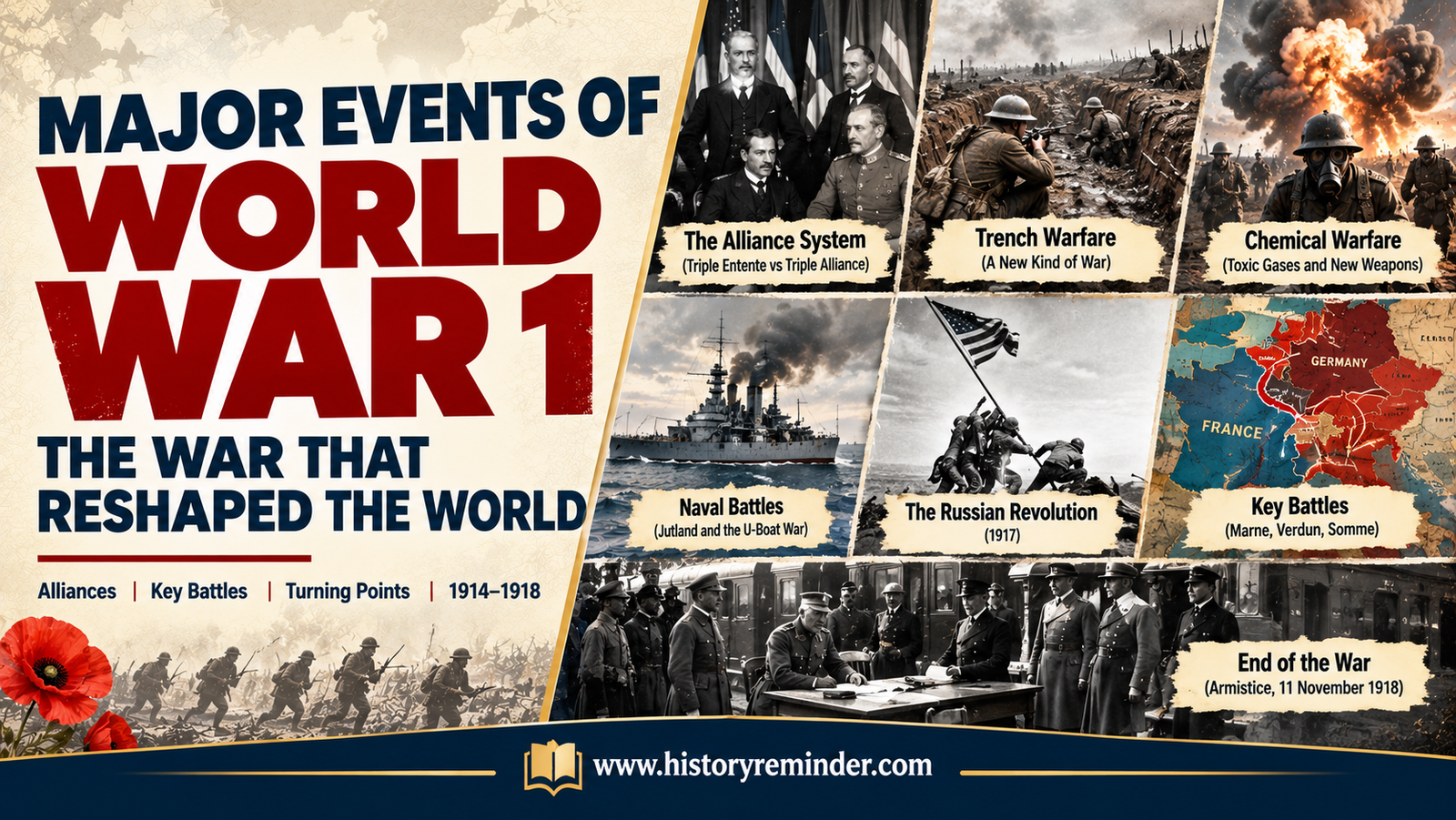
A. The Western Front
The Western Front became one of the most important battle zones of World War 1. It stretched across parts of Belgium and France, where German forces fought against British and French armies. After the initial German advance was halted at the First Battle of the Marne in September 1914, both sides developed extensive trench systems.
Trench warfare exposed soldiers to mud, disease, artillery bombardment, machine-gun fire, and dangerous living conditions. Attacks across open ground often resulted in heavy casualties with limited territorial gains. The Battle of Verdun in 1916 and the Battle of the Somme in the same year became symbols of the enormous human cost of the conflict.
B. The Eastern Front
The Eastern Front involved Germany and Austria-Hungary fighting against Russia. The front covered a much larger geographical area than the Western Front, and armies frequently moved over long distances.
Russia experienced serious military and economic difficulties during the war. Shortages of supplies, transport problems, political dissatisfaction, and heavy casualties weakened the Russian government. The Russian Revolution of 1917 led to the fall of the monarchy and the eventual withdrawal of Russia from the conflict.
C. The Gallipoli Campaign
In 1915, Allied forces launched the Gallipoli Campaign against the Ottoman Empire. The objective was to secure the Dardanelles Strait, open a supply route to Russia, and potentially weaken the Ottoman position.
The campaign involved British, French, Australian, New Zealand, and other Allied troops. Ottoman forces resisted successfully, and the Allies evacuated the peninsula in early 1916. Gallipoli became an important event in Turkish history and in the national memories of Australia and New Zealand.
D. The United States Enters the War
The United States initially remained neutral when the conflict began in 1914. However, German unrestricted submarine warfare threatened ships travelling across the Atlantic. German submarines attacked merchant vessels, including ships carrying civilians and supplies.
In 1917, Germany resumed unrestricted submarine warfare. The discovery of the Zimmermann Telegram, which proposed a German alliance with Mexico in the event of war with the United States, further increased American anger. The United States declared war on Germany on 6 April 1917.
American financial resources, industrial production, and fresh troops strengthened the Allied position. US forces became increasingly important during the final campaigns of 1918.
E. The End of the War
In 1918, Germany launched major offensives on the Western Front but failed to achieve a decisive victory. Allied forces, supported by growing American military strength, gradually pushed German troops back. Meanwhile, Bulgaria, the Ottoman Empire, and Austria-Hungary left the war as their military and political positions collapsed.
Germany faced military defeat, economic hardship, and growing unrest at home. The German emperor, Kaiser Wilhelm II, abdicated in November 1918. An armistice between Germany and the Allies took effect at 11 a.m. on 11 November 1918, ending the fighting on the Western Front.
4. New Weapons and Technology
The World War introduced or expanded the use of military technologies that changed modern warfare. Machine guns, heavy artillery, poison gas, tanks, submarines, and military aircraft were used in different theatres of the conflict.
Poison gas caused severe injuries and required soldiers to use protective equipment. Tanks were developed to cross difficult terrain and attack fortified positions, although early models were slow and mechanically unreliable. Aircraft were initially used for reconnaissance but later performed fighter and bombing missions.
Submarines threatened commercial shipping, while improved artillery increased the destructive power of battlefield bombardment. These technologies demonstrated how industrial production and scientific development could increase the scale of warfare.
5. India’s Role in World War 1
India played a significant role in World War 1 because it was part of the British Empire. More than one million Indian soldiers and other personnel served overseas during the conflict, including in Europe, the Middle East, Africa, and other regions.
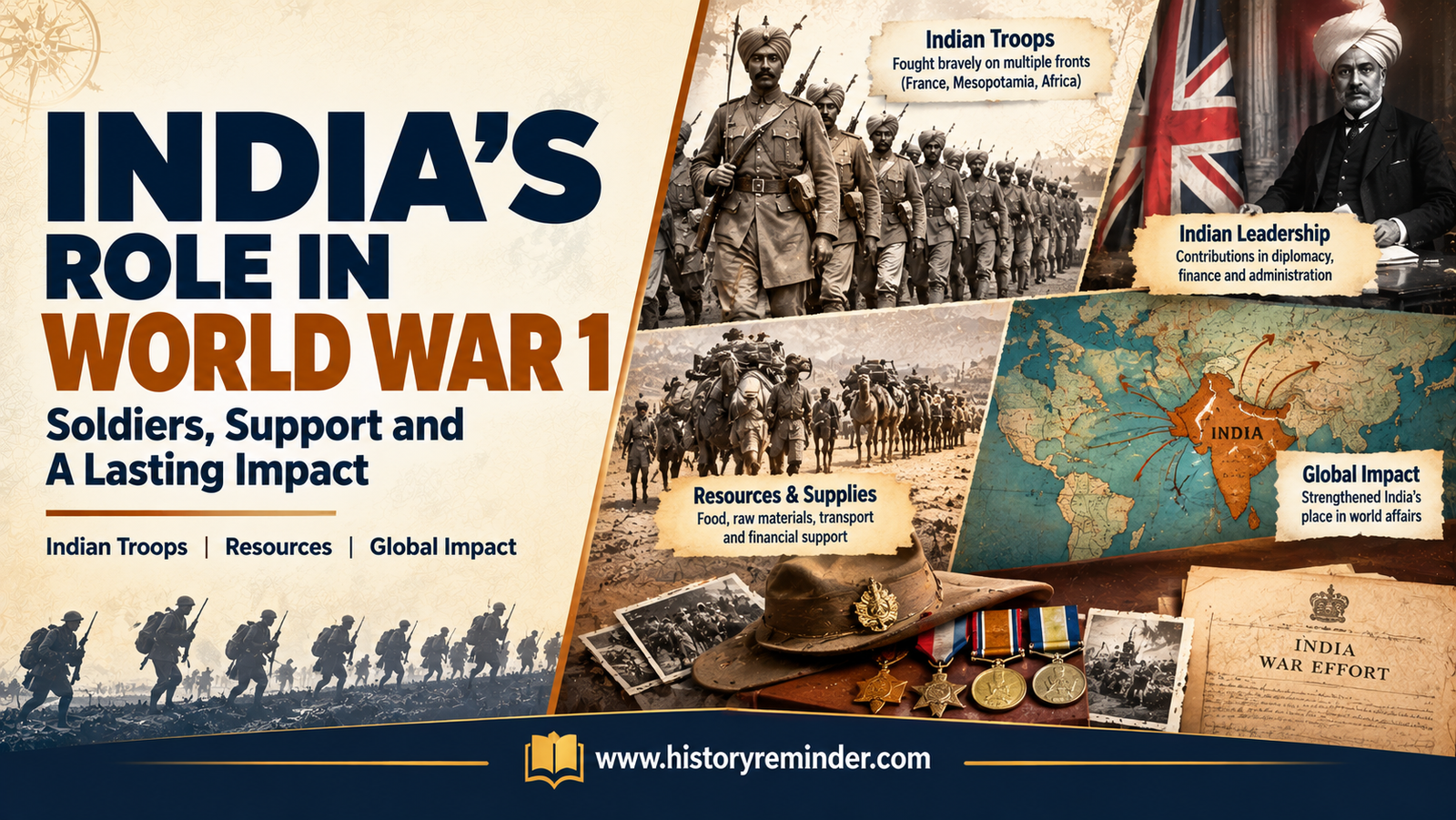
Indian troops fought on the Western Front and in campaigns against Ottoman forces. India also supplied food, raw materials, money, and other resources to support the British war effort. Soldiers came from many different regions and communities, serving in infantry, cavalry, medical, and support units.
The war had major economic and political consequences for India. Increased military expenditure, wartime inflation, taxation, and supply pressures affected ordinary people. Indian political leaders also expected greater constitutional progress in return for wartime contributions.
However, post-war political developments disappointed many Indians. Repressive policies and the limited pace of political reform contributed to the growth of the Indian independence movement. The effects of World War 1 therefore extended beyond the battlefield and influenced India’s struggle against British colonial rule.
6. Consequences of World War 1
A. Human and Economic Losses
World War 1 caused enormous human suffering. Millions of military personnel and civilians died, while many survivors experienced permanent injuries, psychological trauma, displacement, and poverty. Exact casualty figures vary according to the methods used to count military and civilian deaths.
The war also damaged infrastructure, disrupted agriculture, and placed heavy financial burdens on governments. Countries borrowed large sums to pay for military operations, while many European economies faced inflation, shortages, and reconstruction costs.
B. Fall of Major Empires
The war contributed to the collapse of four major empires: the German, Austro-Hungarian, Russian, and Ottoman empires. New states emerged in Europe and the Middle East, while existing borders were redrawn.
These political changes created new opportunities for national self-government but also produced disputes over territory, minority rights, and national identity. Several of these unresolved tensions influenced international politics during the following decades.
C. Treaty of Versailles
The Treaty of Versailles was signed on 28 June 1919 between Germany and the Allied Powers. It imposed territorial losses, military restrictions, and reparations obligations on Germany. The treaty’s war responsibility provisions became particularly controversial in German political debate.
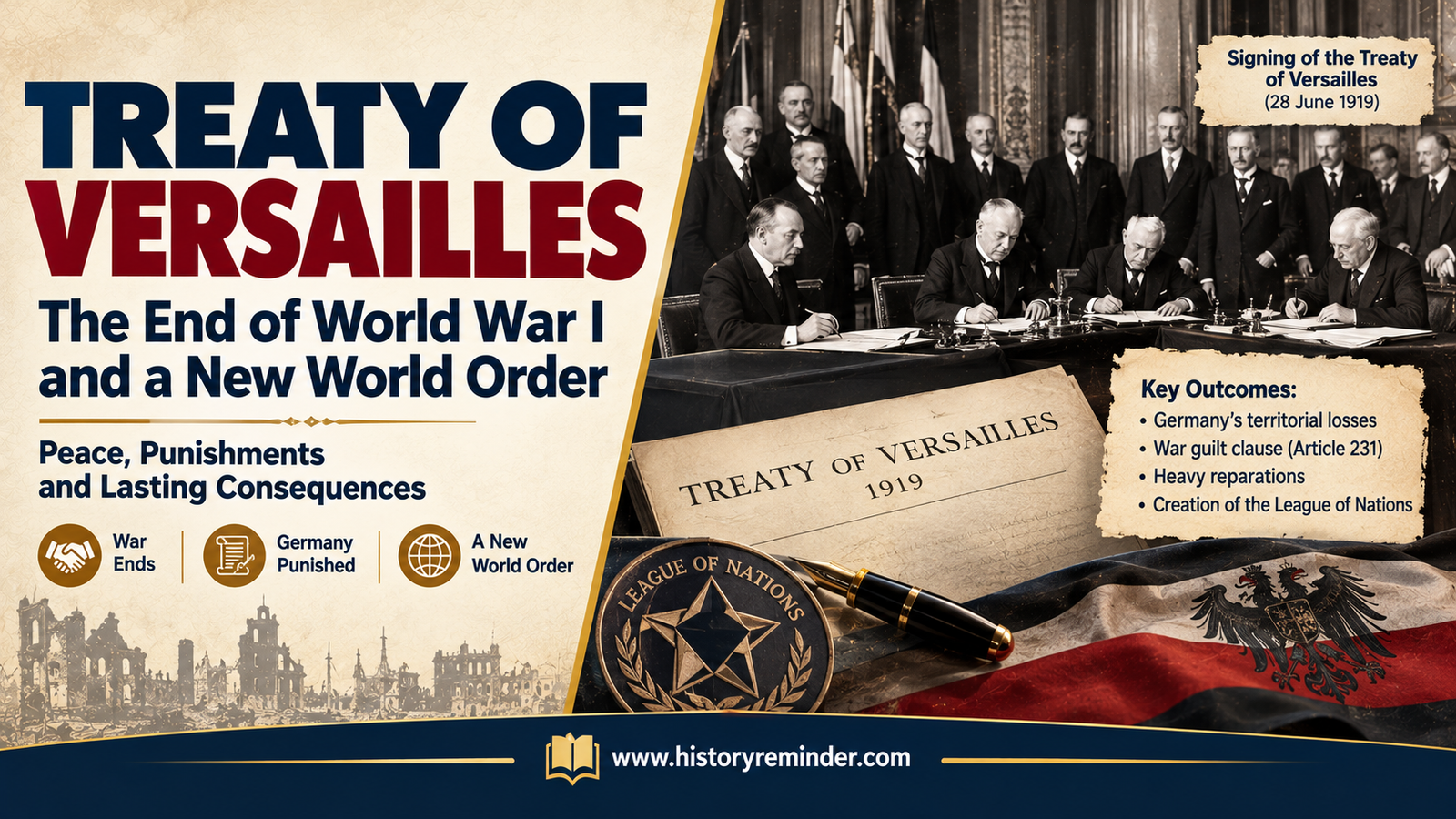
Many Germans considered the treaty humiliating, and resentment over its terms later became an important issue exploited by extremist political movements. However, the treaty was not the only cause of World War II; economic crises, political instability, aggressive expansionism, and the failures of international diplomacy also contributed.
D. Formation of the League of Nations
The League of Nations was established in 1920 as part of the post-war effort to prevent future conflicts through international cooperation. It aimed to encourage peaceful dispute resolution, collective security, and cooperation between countries.
However, the League faced serious limitations. It lacked its own military force, depended on the willingness of member states to act, and struggled to respond effectively to later acts of aggression. These weaknesses reduced its ability to preserve international peace.
7. Historical Significance of World War 1
The significance of World War 1 extends far beyond its military campaigns. It accelerated political change, weakened traditional monarchies, increased demands for national independence, and transformed the relationship between governments and their populations.
The war also expanded the role of governments in economic planning and industrial production. Women entered many jobs previously dominated by men, although these changes did not immediately establish equal rights. In several countries, wartime experiences strengthened movements for women’s political participation.
The conflict reshaped international relations and created conditions that contributed to the instability of the interwar period. Studying the war helps explain the origins of later conflicts, the changing nature of warfare, and the importance of diplomacy in preventing international crises.
Conclusion
World War 1 was a turning point in modern world history. It began with intense rivalries among European powers and developed into a global conflict that affected soldiers, civilians, colonies, and economies across several continents. Nationalism, imperialism, militarism, and alliances created the conditions for war, while the assassination of Archduke Franz Ferdinand triggered the immediate crisis.
The conflict ended in 1918, but its consequences continued for decades. The collapse of empires, the Treaty of Versailles, economic hardship, and unresolved political tensions reshaped the world. Understanding World War 1 helps readers recognise how international rivalries can escalate and why peaceful cooperation remains important in global affairs.
Pingback: World War 2: Causes, Major Events, and Consequences - historyremindercom