

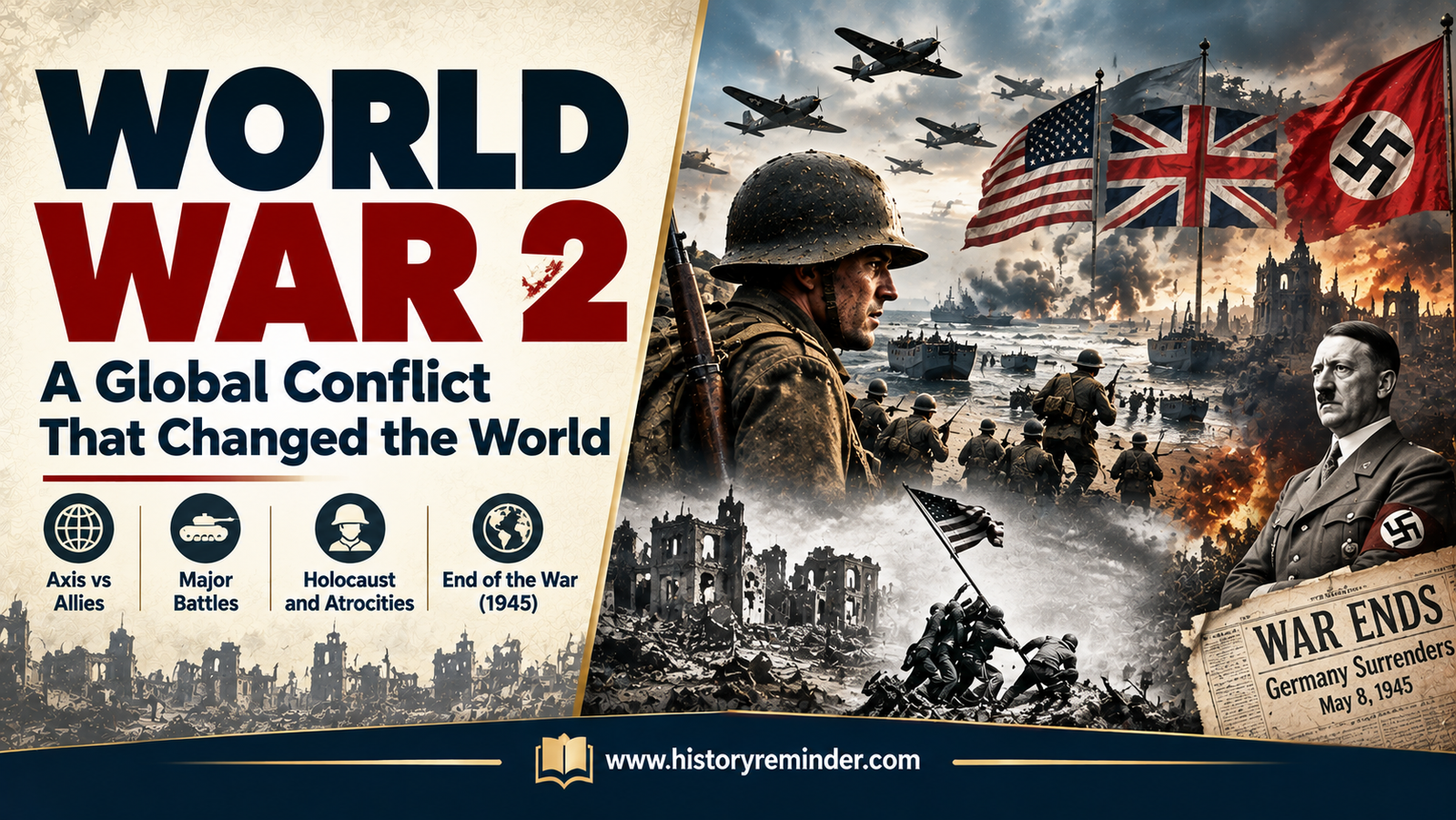
 The history of World War 2 is important because it explains the dangers of aggressive nationalism, dictatorship, racism, and international conflict. The war also led to the establishment of the United Nations, the beginning of the nuclear age, and the emergence of the United States and the Soviet Union as global superpowers.
1. What Was World War 2?
World War 2 was a global military conflict fought mainly between the Allied Powers and the Axis Powers. The principal Axis countries were Germany, Italy, and Japan. The major Allied Powers included Britain, France, the Soviet Union, China, and the United States, although their participation changed as the war developed.
The war in Europe began on 1 September 1939, when Nazi Germany invaded Poland. Britain and France declared war on Germany on 3 September. In Asia, Japan had already been fighting a major war in China since 1937, and its invasion of Manchuria in 1931 marked an earlier stage of Japanese expansionism.
The conflict expanded dramatically after Germany invaded the Soviet Union in June 1941 and Japan attacked the American naval base at Pearl Harbor on 7 December 1941. These events brought the Soviet Union and the United States into the wider conflict as major Allied powers.
2. Major Causes of World War 2
A. Treaty of Versailles
The Treaty of Versailles was signed in 1919 after World War 1. It imposed territorial losses, military restrictions, and reparations obligations on Germany. Many Germans considered the treaty unfair and humiliating, creating resentment that extremist political movements later exploited.
Adolf Hitler and the Nazi Party used public dissatisfaction to gain support. They promised to restore German national pride, rebuild the armed forces, and reverse the territorial restrictions imposed after the First World War. However, the treaty alone did not cause World War 2; economic problems, political instability, militarism, and aggressive expansion also played major roles.
B. Rise of Adolf Hitler and Nazism
Adolf Hitler became German chancellor in January 1933. His government quickly destroyed democratic institutions, established a dictatorship, and persecuted political opponents. The Nazi regime promoted extreme nationalism, antisemitism, racial hierarchy, and territorial expansion.
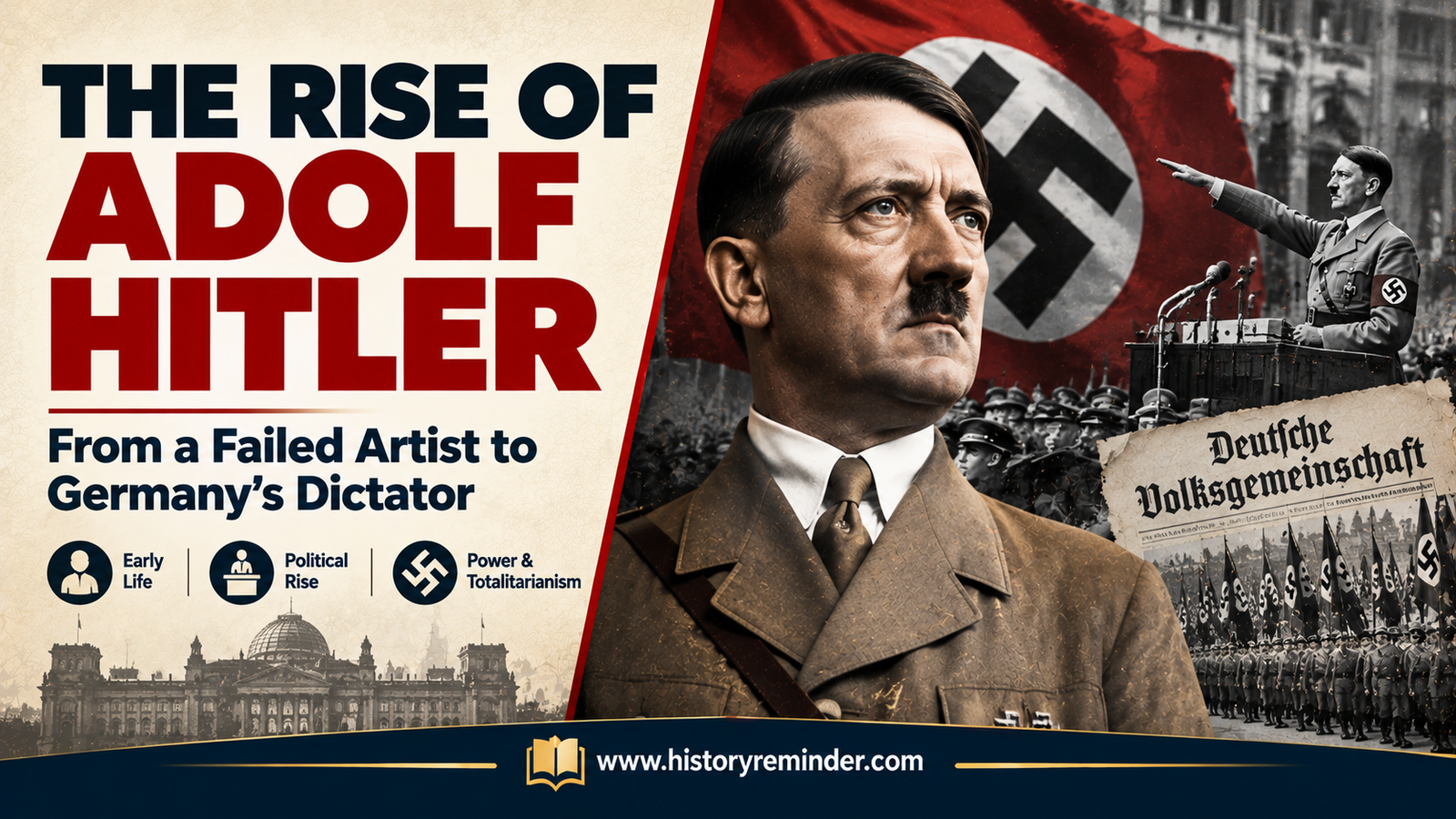
Hitler aimed to expand German territory, particularly eastward, under the Nazi concept of Lebensraum, or living space. The government also rearmed Germany in violation of the post-war settlement and prepared the country for military expansion.
The rise of Nazism was a major factor in the outbreak of World War 2 because the Nazi government repeatedly challenged international agreements and used military force to pursue its objectives.
C. Failure of the League of Nations
The League of Nations was established after World War 1 to maintain international peace. However, it lacked an effective military force and depended on member countries to enforce its decisions.
Japan invaded Manchuria in 1931, and Italy invaded Ethiopia in 1935. The League failed to stop these acts of aggression. Its inability to respond effectively weakened confidence in collective security and encouraged expansionist governments to take further risks.
D. Appeasement Policy
Britain and France followed a policy of appeasement during the 1930s, accepting some of Hitler’s demands in the hope of preventing another major war. In 1938, the Munich Agreement allowed Germany to annex the Sudetenland, a region of Czechoslovakia with a large German-speaking population.
However, Hitler occupied the remaining Czech lands in March 1939. This action demonstrated that his territorial ambitions extended beyond the areas he had claimed. Appeasement did not prevent war, and European tensions increased further.
E. Invasion of Poland
The immediate cause of World War 2 in Europe was Germany’s invasion of Poland on 1 September 1939. German forces used coordinated attacks involving aircraft, tanks, and ground troops to overwhelm Polish defences.
Britain and France had pledged to support Poland and declared war on Germany two days later. The Soviet Union invaded eastern Poland on 17 September 1939 under the secret arrangements of the German-Soviet Non-Aggression Pact. Poland was subsequently divided between Germany and the Soviet Union.
3. Major Events of World War 2
A. German Expansion in Europe
During 1940, Germany rapidly expanded its control over much of Europe. German forces invaded Denmark and Norway in April, followed by attacks on Belgium, the Netherlands, Luxembourg, and France in May.
France was defeated in June 1940. German forces occupied northern and western France, while a collaborationist government based at Vichy administered the southern zone under German influence. Britain continued fighting against Germany, becoming its principal opponent in western Europe at that stage.
B. Battle of Britain
The Battle of Britain took place mainly during the summer and autumn of 1940. The German air force, known as the Luftwaffe, attempted to defeat Britain’s Royal Air Force and gain the air superiority needed for a possible invasion.
British pilots, supported by radar technology, ground crews, and an effective air-defence system, resisted German attacks. Germany failed to establish air superiority and postponed its planned invasion of Britain.
The British victory was significant because Britain remained an active base for Allied resistance in western Europe. It also demonstrated that German military expansion could be stopped.
C. Germany Invades the Soviet Union
On 22 June 1941, Germany launched Operation Barbarossa, a massive invasion of the Soviet Union. Hitler aimed to destroy Soviet military power, seize territory, and gain access to agricultural and natural resources.
German forces initially captured large territories and millions of Soviet soldiers. However, the Soviet Union continued resisting. Long supply lines, harsh winter conditions, determined Soviet counterattacks, and German strategic failures weakened the invasion.
The Battle of Stalingrad, fought from 1942 to early 1943, became a major turning point. Soviet forces surrounded and defeated a large German army, seriously weakening Germany’s position on the Eastern Front.
D. Japan Attacks Pearl Harbor
On 7 December 1941, Japan launched a surprise attack on the American naval base at Pearl Harbor in Hawaii. The attack damaged or destroyed numerous American ships and aircraft and killed more than 2,400 Americans.
The following day, the United States declared war on Japan. Germany and Italy then declared war on the United States. American industrial production, military personnel, and financial resources became central to the Allied war effort.
The attack transformed World War 2 into an even more extensive global conflict, linking the European and Pacific theatres more closely.
E. War in the Pacific
Japan expanded rapidly across East and Southeast Asia during the early stages of the Pacific War. Japanese forces occupied territories including the Philippines, Malaya, Singapore, and the Dutch East Indies.
The Allies gradually reversed Japanese expansion. The Battle of Midway in June 1942 was a major American naval victory that weakened Japan’s carrier fleet. Later, Allied forces advanced through the Pacific using a strategy often called island-hopping, capturing strategically important islands while bypassing some heavily defended positions.
Fighting remained extremely intense. Battles such as Iwo Jima and Okinawa caused heavy casualties among military personnel and civilians, demonstrating the enormous human cost of the Pacific campaign.
4. The Holocaust: One of History’s Greatest Crimes
The Holocaust was the systematic persecution and murder of six million Jews by Nazi Germany and its collaborators. Nazi ideology portrayed Jewish people as racial enemies and gradually stripped them of rights, property, and personal security.
During the war, Nazi authorities established ghettos, carried out mass shootings, and deported Jews to concentration camps and extermination centres. Auschwitz-Birkenau became one of the principal sites of mass murder.
The Nazis and their collaborators also persecuted and murdered millions of other victims, including Roma people, disabled people, Soviet prisoners of war, Polish civilians, and people targeted for political or other reasons.
The Holocaust demonstrates the devastating consequences of antisemitism, racist ideology, state-sponsored discrimination, and the deliberate dehumanisation of entire communities. Remembering these crimes is essential for understanding the importance of human rights and preventing future atrocities.
5. India’s Role in World War 2
India played a major role in World War 2 because it was under British colonial rule. In September 1939, the British government declared India at war with Germany without consulting Indian elected representatives. This decision created serious political tensions.
More than two million Indian personnel served in the British Indian armed forces during the war, making it one of the largest volunteer armies in history. Indian soldiers fought in North Africa, Italy, the Middle East, and Southeast Asia, including major campaigns against Japanese forces in Burma.
Subhas Chandra Bose sought to end British rule through armed struggle and worked with the Axis powers. He became a leading figure associated with the Indian National Army, which fought alongside Japanese forces against British-led troops in Southeast Asia. The INA’s military campaign ultimately failed, but its history influenced political debate in India.
The war also placed severe pressure on India’s economy and food supplies. The Bengal famine of 1943 caused millions of deaths, although historians examine multiple contributing factors, including wartime policies, inflation, distribution problems, and crop and supply disruptions.
World War 2 weakened Britain’s economic and imperial position and contributed to the changing political circumstances that led to Indian independence in 1947. However, independence resulted from a much longer struggle involving many political movements and social groups.
6. The End of World War 2
A. Germany’s Defeat
By 1944, Allied forces were advancing on Germany from both the west and the east. On 6 June 1944, Allied troops landed in Normandy, France, during D-Day. The operation opened a major western front and helped liberate occupied territories.
Soviet forces advanced from the east, while American, British, and other Allied armies moved through western Europe. Berlin was captured by Soviet forces in the spring of 1945. Adolf Hitler died by suicide on 30 April 1945, and Germany surrendered unconditionally. The surrender took effect in Europe in May 1945.
B. Atomic Bombs and Japan’s Surrender
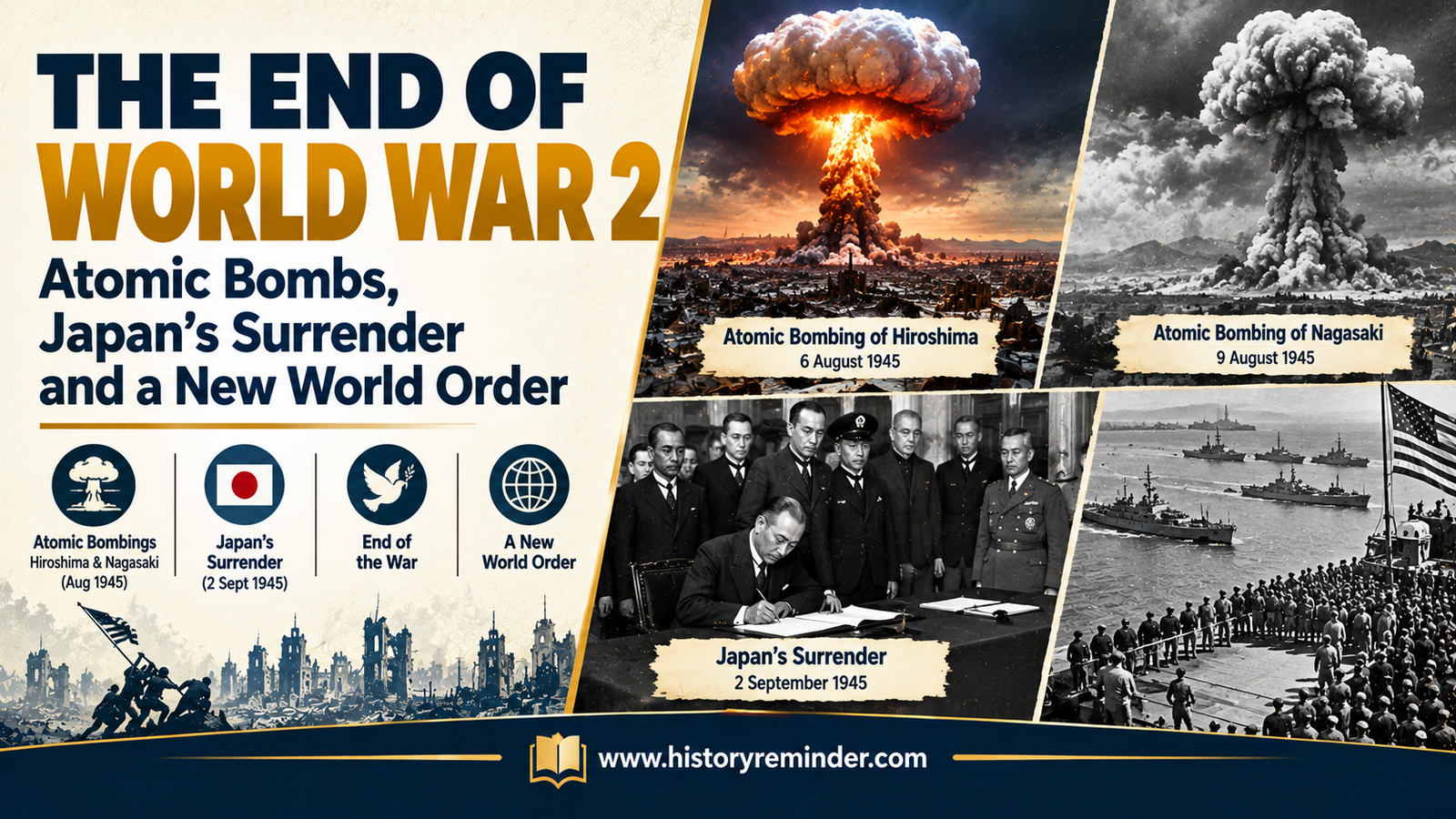
In August 1945, the United States dropped atomic bombs on Hiroshima on 6 August and Nagasaki on 9 August. The bombings killed tens of thousands of people immediately, with many more dying later from injuries and radiation-related illnesses.
The Soviet Union also declared war on Japan on 8 August 1945 and launched an offensive against Japanese forces in Manchuria. Facing military defeat, the effects of the atomic bombings, and the Soviet entry into the war, Japan announced its surrender on 15 August. The formal surrender was signed on 2 September 1945, marking the end of World War 2.
7. Major Consequences of World War 2
A. Human and Economic Losses
World War 2 caused an estimated 70 to 85 million deaths, including military personnel and civilians. The destruction of cities, transport systems, factories, and agricultural regions left many countries facing enormous reconstruction challenges.
Millions of people were displaced, and survivors struggled with shortages of food, housing, and medical care. The war’s economic consequences continued long after the fighting ended.
B. Formation of the United Nations
The United Nations was officially established on 24 October 1945 to promote international cooperation, peace, security, and human rights. Its creation reflected the determination of many governments to prevent another global conflict.
Unlike the League of Nations, the United Nations developed a Security Council with five permanent members: the United States, the Soviet Union, Britain, France, and China. These countries received veto powers over substantive decisions.
C. Beginning of the Cold War
After the war, the United States and the Soviet Union emerged as the two most powerful countries in the world. Their competing political and economic systems, security concerns, and struggles for international influence contributed to the Cold War.
The Cold War involved military alliances, nuclear competition, intelligence operations, political pressure, and indirect conflicts. Although the United States and the Soviet Union did not fight a full-scale direct war against each other, their rivalry shaped global politics for decades.
D. Decolonisation and Changing World Politics
World War 2 weakened European colonial powers and strengthened demands for independence across Asia, Africa, and the Middle East. Anti-colonial movements gained momentum as people challenged the legitimacy of continued foreign rule.
India became independent in 1947, while many other countries achieved independence during the following decades. The war therefore accelerated major changes in the international political system.
Conclusion
World War 2 was a defining event in modern history. It resulted from aggressive expansionism, dictatorship, militarism, and the failure of international efforts to prevent conflict. The war involved major battles across Europe and the Pacific, the Holocaust, and the use of atomic weapons.
Its consequences included the defeat of Nazi Germany and Imperial Japan, the collapse of several political structures, the formation of the United Nations, and the beginning of the Cold War. The conflict also accelerated decolonisation and changed the balance of global power.
Studying World War 2 helps us understand how intolerance, extreme nationalism, and unchecked aggression can lead to catastrophic suffering. Its history remains a powerful reminder of the importance of international cooperation, historical awareness, and the protection of human rights.
Pingback: World War 1: Causes, Events, and Consequences - historyremindercom
yes there are a combination of factors.