

Introduction to Medieval Indian History
Medieval history is an important part of India’s past because it witnessed major political, economic, religious, and cultural transformations. During this period, several powerful kingdoms and empires emerged, trade networks expanded, new architectural styles developed, and different religious and cultural traditions interacted across the Indian subcontinent.
The period is generally associated with the centuries between the decline of the ancient imperial systems and the expansion of European colonial power. It witnessed the rise of regional kingdoms, the Delhi Sultanate, the Mughal Empire, and several influential powers in southern and western India. These developments shaped the political and cultural landscape of the subcontinent.
The study of medieval history is not limited to kings and battles. It also helps us understand the lives of ordinary people, agricultural communities, traders, artisans, religious groups, and women. Inscriptions, coins, monuments, manuscripts, and travellers’ accounts provide valuable evidence about how society changed over time.
1. Periodisation of Medieval Indian History
Historians do not always agree on the exact beginning and ending dates of medieval Indian history. Some educational frameworks begin the period around the 6th century CE, following the decline of the Gupta Empire, while others use approximately 700 CE or 1206 CE as a starting point for particular historical developments.
For educational purposes, the period can be divided into three broad phases:
- Early Medieval Period (approximately 600–1200 CE): The emergence of regional kingdoms, expansion of agriculture, development of temple institutions, and growth of regional cultures.
- Delhi Sultanate Period (1206–1526 CE): The establishment of successive Sultanate dynasties and the expansion of political authority from Delhi.
- Mughal and Regional Powers (1526–18th century): The expansion of the Mughal Empire, the rise of regional kingdoms, and the growing influence of European trading companies.
These divisions are useful for understanding broad developments, but they should not be treated as fixed boundaries. Different regions experienced political and cultural changes at different times.
2. Important Kingdoms and Dynasties of Early Medieval India
After the decline of the Gupta Empire, political power became increasingly distributed among regional kingdoms. Several dynasties emerged and competed for control over fertile territories, trade routes, and important political centres.
Gurjara-Pratihara Dynasty
The Gurjara-Pratiharas became an influential power in northern India between the 8th and 10th centuries. They played an important role in the political struggles over Kannauj, a strategically important city in northern India.
Their rulers competed with the Palas of Bengal and the Rashtrakutas of the Deccan in what historians commonly describe as the Tripartite Struggle. This prolonged competition demonstrates how important Kannauj was as a centre of political authority.
Pala Dynasty
The Pala dynasty ruled large parts of Bengal and Bihar. Gopala is traditionally regarded as the founder of the dynasty in the 8th century. Important rulers included Dharmapala and Devapala, who expanded Pala influence.
The Palas were important patrons of Buddhism. Their support helped educational and religious institutions such as Nalanda and Vikramashila flourish. Pala-period sculpture, manuscripts, and bronze images also influenced artistic traditions in eastern India and beyond.
Rashtrakuta Dynasty
The Rashtrakutas emerged as a major political power in the Deccan. Their influence extended into parts of central and southern India, and they frequently competed with other powerful dynasties for territory and prestige.
One of their most remarkable contributions was the Kailasa Temple at Ellora, commissioned under the Rashtrakuta ruler Krishna I. This enormous rock-cut temple demonstrates the advanced architectural and artistic skills of the period.
Chola Dynasty
The Cholas became one of the most powerful dynasties in southern India. Under rulers such as Rajaraja I and Rajendra I, the empire expanded across large parts of southern India and developed strong maritime connections.
The Cholas are particularly remembered for their administrative organisation, irrigation systems, temple architecture, and overseas military expeditions. Their naval activities extended their influence across parts of the Bay of Bengal and Southeast Asia.
The Brihadisvara Temple at Thanjavur, constructed under Rajaraja I in the early 11th century, is a major example of Chola architecture. Chola bronze sculptures, especially representations of Shiva as Nataraja, remain celebrated examples of Indian artistic achievement.
3. The Delhi Sultanate (1206–1526 CE)
The Delhi Sultanate marked an important phase in the political history of northern India. It was established in 1206 CE after the death of Muhammad Ghori, when Qutb-ud-din Aibak became an independent ruler.
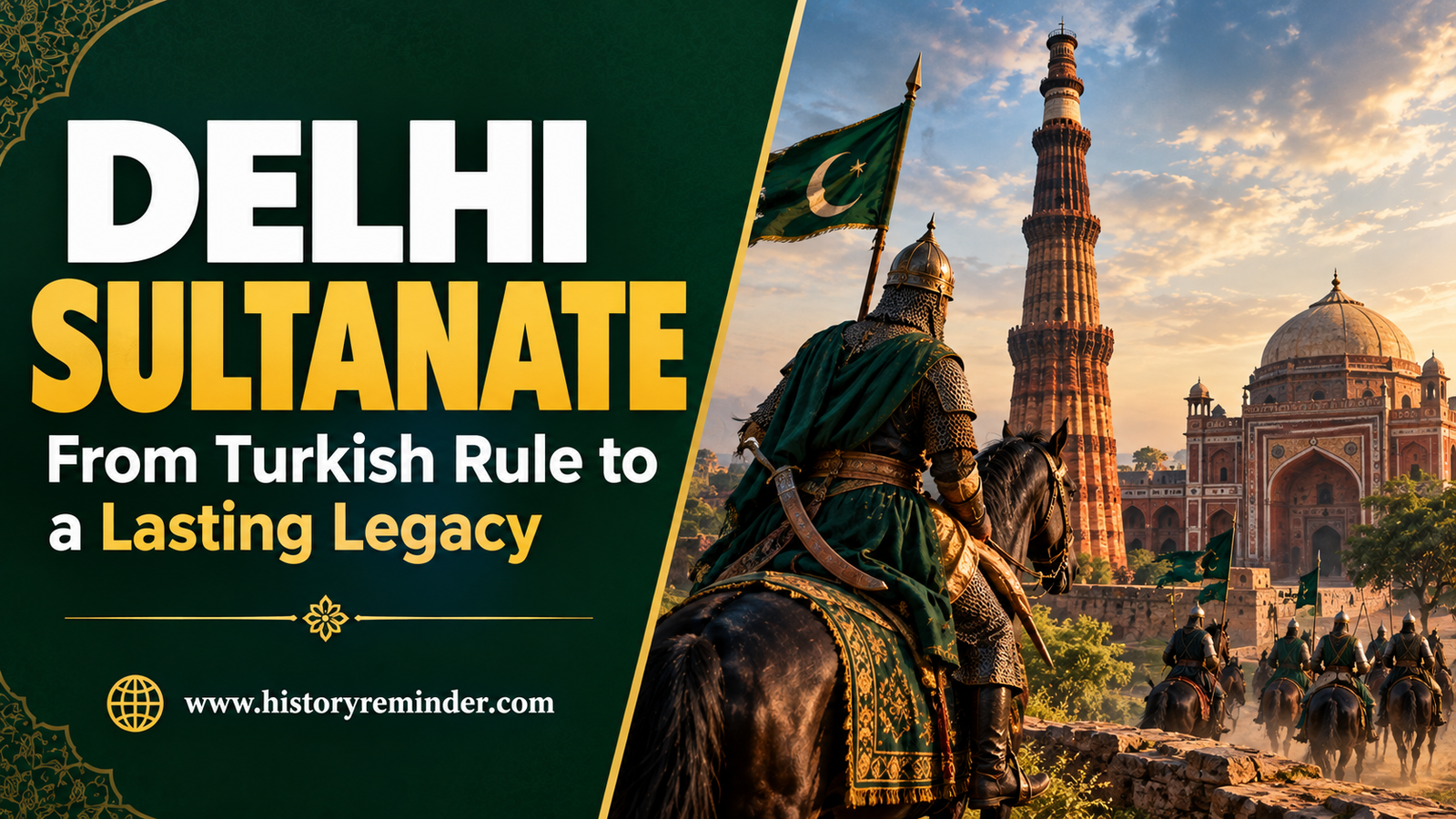
The Delhi Sultanate consisted of five major ruling dynasties:
- Mamluk or Slave Dynasty (1206–1290): Founded by Qutb-ud-din Aibak. Important rulers included Iltutmish, Razia Sultan, and Balban.
- Khalji Dynasty (1290–1320): Known especially for Alauddin Khalji’s military expansion and market regulations.
- Tughlaq Dynasty (1320–1414): Included Muhammad bin Tughlaq and Firuz Shah Tughlaq, whose reigns involved significant administrative experiments and public works.
- Sayyid Dynasty (1414–1451): A comparatively weaker dynasty that ruled Delhi after the Tughlaq period.
- Lodi Dynasty (1451–1526): An Afghan ruling dynasty that came to an end following Babur’s victory at the First Battle of Panipat.
Important Rulers of the Delhi Sultanate
Iltutmish: He consolidated the Sultanate and strengthened its political institutions. He also developed the use of the silver tanka and copper jital as important currency denominations.
Razia Sultan: She ruled from 1236 to 1240 and became one of the most notable women to occupy the throne of Delhi. Her reign faced opposition from powerful nobles.
Alauddin Khalji: He expanded the Sultanate’s territories and introduced market regulations to control the prices of essential goods. His military policies also helped resist Mongol attacks.
Muhammad bin Tughlaq: He is remembered for ambitious administrative experiments, including the attempted transfer of the capital from Delhi to Daulatabad and the introduction of token currency. Several of these experiments faced serious implementation problems.
Firuz Shah Tughlaq: He is associated with the construction of canals, gardens, towns, and public buildings. He also supported educational and charitable institutions.
The Sultanate period contributed to the development of new political institutions, urban centres, architectural traditions, and Persianate cultural influences in India.
4. The Mughal Empire (1526–18th Century)
The Mughal Empire was one of the most influential imperial powers in Indian history. It was established by Babur after his victory over Ibrahim Lodi at the First Battle of Panipat in 1526.
Babur (1526–1530)
Babur founded Mughal rule in India and introduced military techniques that included the effective use of firearms and field artillery. His victory at Panipat helped establish a new political power in northern India.
His autobiography, the Baburnama, is an important historical source containing information about his experiences, political campaigns, observations of nature, and descriptions of society.
Humayun (1530–1540 and 1555–1556)
Humayun faced strong opposition from Afghan ruler Sher Shah Suri and temporarily lost control of the Mughal territories. He later regained Delhi in 1555 with Persian support but died in 1556.
Akbar (1556–1605)
Akbar was one of the most influential Mughal emperors. He expanded the empire through military campaigns, diplomatic alliances, and administrative reforms.
One of his major administrative developments was the Mansabdari system, which organised imperial officials and military responsibilities according to ranks. He also introduced important revenue reforms with the assistance of Raja Todar Mal.
Akbar promoted political alliances with several Rajput rulers and developed policies that encouraged cooperation among different communities. His religious discussions at the Ibadat Khana in Fatehpur Sikri and his interest in different philosophical traditions remain significant features of his reign.
Jahangir (1605–1627)
Jahangir continued many of Akbar’s administrative and cultural policies. His reign is particularly remembered for painting, court culture, and his autobiography, the Tuzuk-i-Jahangiri.
Shah Jahan (1628–1658)
Shah Jahan is best known for his architectural achievements. The Taj Mahal at Agra, built in memory of Mumtaz Mahal, is among the finest examples of Mughal architecture. He also commissioned the Red Fort in Delhi and the Jama Masjid.
Aurangzeb (1658–1707)
Aurangzeb ruled for nearly five decades and expanded the Mughal Empire to its greatest territorial extent. However, prolonged Deccan campaigns, political conflicts, regional resistance, and the growing costs of imperial administration placed considerable pressure on the empire.
His reign was followed by a gradual weakening of central Mughal authority and the emergence of stronger regional powers.
5. Rise of Regional Powers
Indian political life was never limited to the Delhi Sultanate and Mughal Empire. Several independent and regional powers played major roles in shaping the subcontinent.
Vijayanagara Empire
The Vijayanagara Empire was established in 1336 by Harihara and Bukka in southern India. Its capital, Vijayanagara, near present-day Hampi in Karnataka, became a major centre of political authority, commerce, religion, and architecture.
Krishnadevaraya, who ruled from 1509 to 1529, is considered one of its most successful rulers. The empire supported temple construction, literature, irrigation, and trade. The monuments at Hampi provide valuable evidence of its artistic and architectural achievements.
Bahmani Sultanate
The Bahmani Sultanate was established in the Deccan in 1347 by Ala-ud-Din Bahman Shah. It became an important regional power and frequently competed with Vijayanagara for control over the strategically important Raichur Doab.
Its political and cultural legacy continued through the Deccan Sultanates that emerged after its fragmentation.
Maratha Power
The Marathas emerged as a major political force during the 17th century under the leadership of Shivaji. He established an independent kingdom and developed an administrative and military system suited to the geographical conditions of the Deccan.
Shivaji’s military strategy made effective use of forts, mobile forces, and knowledge of local terrain. After his death, the Maratha state continued to expand and became a major political power in the 18th century.
6. Economy, Agriculture and Trade
Agriculture was the foundation of the medieval Indian economy. Most people lived in villages and depended on farming. Major crops included rice, wheat, barley, pulses, cotton, and sugarcane, although agricultural patterns differed according to regional climate and soil conditions.
Land revenue was an important source of income for rulers. Different kingdoms developed systems to assess agricultural production and collect taxes. Under the Mughals, Akbar’s revenue administration, associated with Raja Todar Mal, attempted to standardise land measurement and revenue assessment across important imperial territories.
Trade and commerce also expanded during these centuries. Indian merchants traded textiles, spices, precious stones, metal goods, and other products through inland routes and maritime networks.
Important commercial centres included Surat, Cambay, Masulipatnam, and other port cities. Indian Ocean trade connected Indian merchants with West Asia, East Africa, Southeast Asia, and European trading communities.
Craft industries were also important. Textile production, metalworking, shipbuilding, jewellery making, and pottery provided employment to many communities. Indian cotton textiles, in particular, became valuable commodities in international markets.
7. Religion, Bhakti and Sufi Movements
Religious and philosophical developments played an important role in shaping medieval Indian society. The Bhakti and Sufi movements encouraged spiritual devotion and contributed to the growth of regional languages, poetry, music, and religious communities.
Bhakti Movement
The Bhakti movement emphasised personal devotion to a deity rather than relying exclusively on elaborate rituals. Its traditions developed differently across regions and centuries.
Important Bhakti saints included:
- Ramanuja: Associated with the Vishishtadvaita school of Vedanta.
- Kabir: Known for his criticism of religious divisions and emphasis on devotion to one supreme reality.
- Mirabai: Remembered for devotional poetry dedicated to Krishna.
- Guru Nanak: Founder of Sikhism, who emphasised devotion, equality, honest living, and service.
- Tulsidas: Known for composing the Ramcharitmanas in Awadhi.
Sufi Movement
Sufism represents mystical traditions within Islam that emphasised spiritual development, devotion, and closeness to God. Sufi teachers established centres known as khanqahs, where followers gathered for spiritual instruction and community activities.
Important Sufi figures in India included Khwaja Moinuddin Chishti of Ajmer and Nizamuddin Auliya of Delhi. Their teachings and institutions attracted followers from different social backgrounds.
Both Bhakti and Sufi traditions contributed to the development of India’s diverse religious and cultural environment, although their beliefs and practices were not identical.
8. Art, Architecture and Literature
One of the most visible legacies of this period is its architecture. Different rulers supported temples, mosques, forts, palaces, tombs, stepwells, and educational institutions.
Indo-Islamic architecture combined building techniques and decorative traditions from different regions. The Qutb Minar complex in Delhi is an important early example of this architectural development. Construction of the tower began under Qutb-ud-din Aibak and continued under later rulers.
Mughal architecture developed a distinctive style using domes, arches, gardens, decorative stonework, and symmetrical layouts. Major examples include:
- Qutb Minar: An important monument associated with the early Delhi Sultanate.
- Humayun’s Tomb: A major example of Mughal garden-tomb architecture in Delhi.
- Fatehpur Sikri: Akbar’s planned imperial city, built in the second half of the 16th century.
- Taj Mahal: A world-famous Mughal monument commissioned by Shah Jahan.
- Hampi: A remarkable collection of monuments associated with the Vijayanagara Empire.
Literature also developed in several languages. Persian was widely used in many royal courts, while regional languages such as Hindi, Bengali, Marathi, Tamil, Telugu, and Punjabi experienced important literary developments.
Historical works, devotional poetry, biographies, court chronicles, and travel accounts provide valuable information about the political and social conditions of the period.
9. Science, Technology and Education
Scientific and technological developments continued during these centuries. Agricultural techniques, irrigation systems, metalworking, textile production, shipbuilding, and military technology developed through regional innovation and the exchange of knowledge.
The use of gunpowder weapons and field artillery became increasingly significant in warfare, particularly during the establishment and expansion of the Mughal Empire. Water-management structures, including canals, tanks, wells, and stepwells, supported agriculture and urban life.
Education took place through a variety of institutions, including madrasas, temple schools, monasteries, and centres of scholarly learning. Subjects included religion, philosophy, mathematics, astronomy, literature, medicine, and law.
Knowledge also travelled through trade, migration, diplomatic relations, and the movement of scholars. These exchanges contributed to the development of intellectual and technical traditions across different regions.
10. Historical Sources: How Do We Study This Period?
Understanding the past requires historians to examine evidence rather than depend only on popular stories or simplified accounts. A variety of historical sources help reconstruct political events, economic conditions, and everyday life.
Important Sources
- Inscriptions: Stone and copper-plate inscriptions provide information about rulers, land grants, religious donations, administration, and political achievements.
- Coins: Coins help historians understand trade, economic activity, rulers, political authority, and monetary systems.
- Literary records: Court chronicles, biographies, religious texts, and regional literature reveal contemporary ideas and events.
- Foreign travellers’ accounts: Writers such as Al-Biruni and Ibn Battuta described aspects of Indian society, customs, administration, and economic life.
- Monuments and archaeological remains: Forts, temples, mosques, tombs, pottery, and other remains provide physical evidence of past societies.
These sources must be examined critically. A royal inscription may exaggerate a ruler’s victories, while a traveller may describe only the regions and communities that he personally encountered. Historians compare different types of evidence to develop a more balanced interpretation.
11. Decline of the Mughal Empire and the Transition to Colonial Rule
The decline of the Mughal Empire accelerated after the death of Aurangzeb in 1707. The empire continued to exist, but its central authority gradually weakened as regional rulers became increasingly independent.
Several factors contributed to this process, including succession conflicts, financial pressures, prolonged military campaigns, regional resistance, and administrative challenges. The emergence of powerful states such as the Marathas, Awadh, Bengal, and Hyderabad further changed the political balance.
European trading companies also became increasingly involved in Indian politics. The English East India Company gradually expanded its influence through trade, military intervention, and political alliances.
The Battle of Plassey in 1757 and the Battle of Buxar in 1764 were important turning points in the expansion of Company power in eastern India. In 1765, the Company obtained the Diwani rights for Bengal, Bihar, and Orissa from the Mughal emperor Shah Alam II, giving it the right to collect revenue in these territories.
These developments marked a major transition in Indian political and economic history. The Mughal emperor continued to hold symbolic importance, but effective political power increasingly passed to regional states and the East India Company.
12. Importance and Legacy of Medieval Indian History
The period between the early medieval centuries and the 18th century transformed many aspects of Indian civilisation. It witnessed the expansion of regional languages, the growth of commercial cities, the development of new administrative institutions, and the interaction of diverse religious and cultural traditions.
Its legacy can still be seen in India’s architecture, music, literature, religious practices, food traditions, regional identities, and historical monuments.
Studying medieval history also helps explain the formation of political institutions and the development of connections between different regions. It reveals that Indian society was not static but continuously changed through migration, trade, conflict, cooperation, and cultural exchange.
For students, this period provides an important foundation for understanding the transition from ancient political systems to early modern India and the eventual expansion of colonial rule.
Conclusion
Medieval Indian history was a period of significant political, social, economic, and cultural transformation. From the regional kingdoms of the early medieval period to the Delhi Sultanate, Mughal Empire, Vijayanagara, and Maratha powers, different rulers and communities shaped the subcontinent’s development.
Its importance extends beyond the achievements of emperors and military commanders. The growth of trade, regional languages, religious movements, architecture, literature, and educational institutions demonstrates the complexity of Indian society during these centuries.
Understanding medieval history through inscriptions, monuments, coins, literary works, and archaeological evidence helps us develop a more balanced picture of India’s past. Its legacy remains visible in the country’s cultural diversity and historical heritage.