

Introduction
The Gurjara-Pratihara Dynasty was one of the most powerful ruling dynasties of early medieval northern India. It played an important role in shaping the political history of the Indian subcontinent between the 8th and 11th centuries CE. The dynasty controlled large territories across present-day Rajasthan, Gujarat, Madhya Pradesh, and parts of northern India. Its rulers were known for their military strength, political ambitions, temple patronage, and resistance to rival powers.
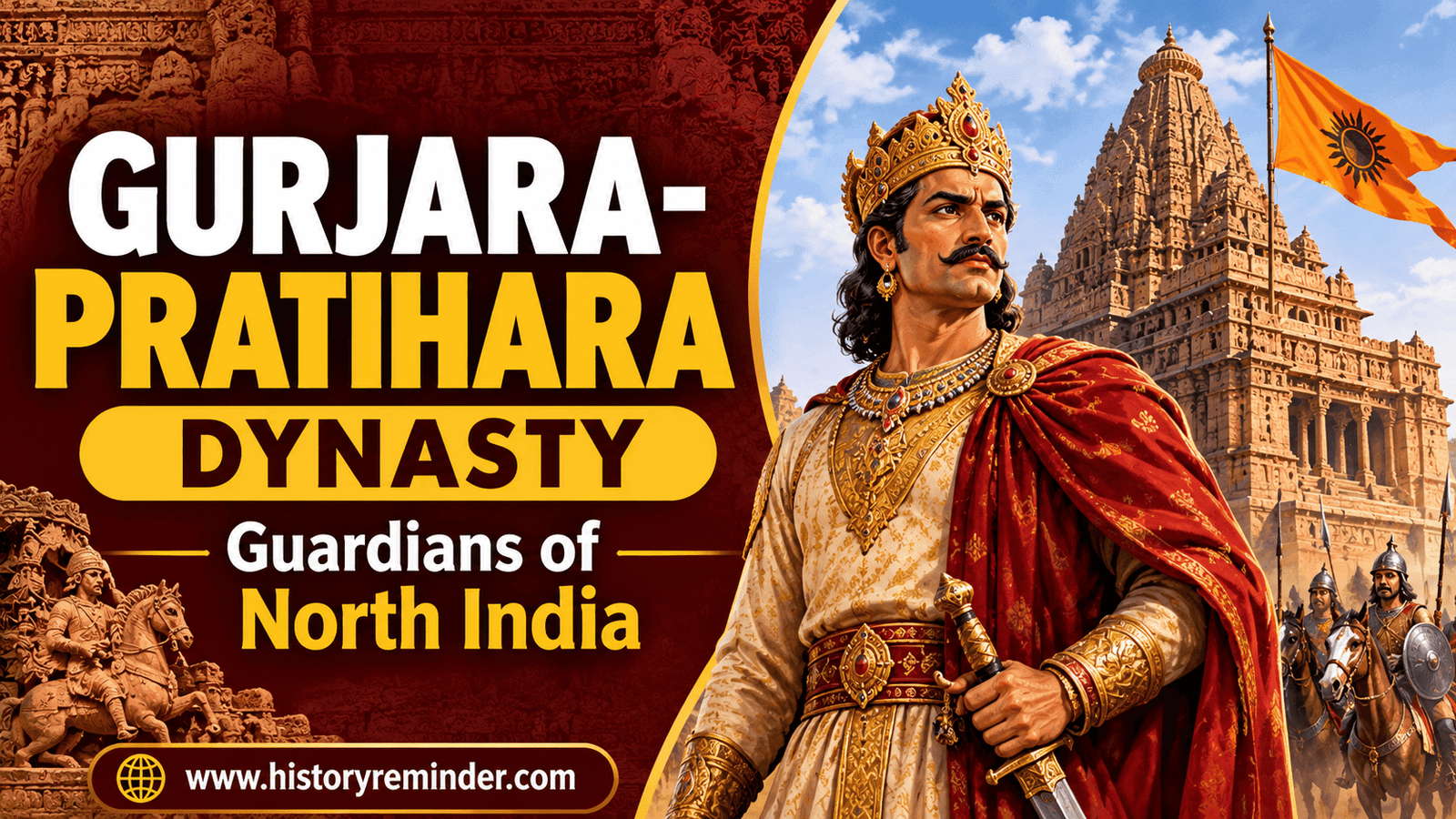
The rise of the Pratiharas marked an important development in a history of ancient and early medieval india. After the decline of the Gupta Empire, political authority became divided among several regional kingdoms. The Pratiharas emerged as a major power during this period and competed with the Palas of Bengal and the Rashtrakutas of the Deccan for control over Kannauj.
Their political influence, military campaigns, and cultural contributions make this dynasty an essential subject for understanding the development of northern India. In particular, its rulers played an important role in the changing political landscape of the early medieval period.
1. Origin and Foundation of the Pratihara Dynasty
The exact origin of the Pratiharas remains a subject of historical discussion. Different inscriptions, literary traditions, and later accounts provide information about their ancestry. The term Gurjara is associated with their historical identity and the region in which their power developed. However, historians continue to debate the precise relationship between the Gurjaras as a people, a geographical region, and the ruling family.
The Pratihara rulers traditionally connected their lineage with Lakshmana, the brother of Lord Rama. According to this tradition, Lakshmana served as a protector or pratihara, which became associated with the dynasty’s name. This is an important example of how royal families used religious traditions to establish their political legitimacy.
Historical evidence suggests that the dynasty developed its power in western India, particularly in areas of present-day Rajasthan. Over time, it expanded towards central and northern India. The early rulers gradually built a political and military structure that allowed them to compete with other regional powers.
For students studying a history of ancient and early medieval india, the emergence of the Pratiharas illustrates how regional kingdoms developed after the decline of large ancient empires.
2. Important Rulers of the Gurjara-Pratihara Dynasty
Several rulers contributed to the expansion and political strength of the dynasty. Their military campaigns and administrative policies helped establish Pratihara authority across northern India.
Nagabhata I (c. 730–760 CE)
Nagabhata I is generally considered one of the earliest major rulers of the dynasty. He established a strong political base in western India and expanded Pratihara influence into neighbouring territories.
He is particularly remembered for resisting Arab military expansion into parts of western India. Arab forces had established their presence in Sindh during the early 8th century and attempted to expand further into the subcontinent. Later historical accounts and inscriptions associate Nagabhata I with victories against invading forces.
His military achievements helped strengthen the position of the early Pratihara state and created a foundation for future expansion.
Vatsaraja (c. 775–800 CE)
Vatsaraja was another important ruler who expanded Pratihara influence. During his reign, the dynasty became involved in the struggle for control over Kannauj, one of the most important political centres of northern India.
His expansion brought him into conflict with the Pala ruler Dharmapala of Bengal. The competition between these powers eventually developed into a larger political struggle involving the Rashtrakutas of the Deccan.
Nagabhata II (c. 800–833 CE)
Nagabhata II strengthened the position of the dynasty after a period of political challenges. He successfully recovered important territories and established control over Kannauj, making it the centre of Pratihara political authority.
His campaigns against rival kingdoms helped expand the influence of the ruling family. The acquisition of Kannauj was particularly significant because of its strategic location and political importance.
Mihira Bhoja (c. 836–885 CE)
Mihira Bhoja was one of the greatest rulers of the dynasty. His reign marked a period of considerable political strength and territorial expansion. He controlled large parts of northern and central India and strengthened the military and administrative organisation of his kingdom.
Mihira Bhoja is also associated with the title Adivaraha. Coins bearing the Adivaraha name and religious symbolism are important evidence of his royal authority and religious associations.
His court became an important centre of political activity, and the dynasty reached one of its strongest positions during his rule. His success made the Pratiharas a major power in the competition for northern Indian supremacy.
Mahendrapala I (c. 885–910 CE)
Mahendrapala I succeeded Mihira Bhoja and continued the expansion of the empire. His authority extended over important regions of northern India, and he maintained the political influence established by his predecessor.
His reign is also associated with cultural and literary development. The Sanskrit scholar and poet Rajasekhara was connected with the Pratihara court. His works provide useful information about literary culture and courtly life during this period.
3. The Tripartite Struggle for Kannauj
One of the most important political developments involving the Pratiharas was the Tripartite Struggle. It was a prolonged competition among three powerful dynasties: the Gurjara-Pratiharas of northern and western India, the Palas of Bengal, and the Rashtrakutas of the Deccan.
The main objective of this struggle was control over Kannauj. Located in the fertile Ganga-Yamuna region, Kannauj was an important political, economic, and strategic centre. Control over the city provided prestige and helped rulers strengthen their influence in northern India.
Why Was Kannauj Important?
- Political importance: Kannauj had become an important centre of royal authority in northern India.
- Geographical location: Its position in the Ganga plain made it strategically valuable.
- Economic resources: The surrounding agricultural region supported revenue collection and trade.
- Royal prestige: Control over Kannauj strengthened a ruler’s political status among rival kingdoms.
The struggle developed through several military campaigns. Vatsaraja of the Pratiharas competed with Dharmapala of the Palas, while the Rashtrakuta ruler Dhruva intervened in northern Indian politics. Later, Nagabhata II recovered Kannauj and strengthened Pratihara authority.
The Rashtrakutas also launched campaigns into northern India. Rulers such as Govinda III and Indra III challenged Pratihara power at different times. These interventions prevented any one dynasty from maintaining uninterrupted supremacy.
The Tripartite Struggle is an important topic in a history of ancient and early medieval india because it demonstrates the political competition, military strategies, and regional ambitions of major Indian kingdoms.
4. Administration of the Pratihara Empire
The Pratiharas maintained an administrative system that helped them govern a large territory with different regional communities and local power structures. The king stood at the centre of political authority and was responsible for military campaigns, administration, justice, and the protection of the kingdom.
The administration included ministers, military commanders, provincial officers, and local authorities. Different regions were governed through a combination of royal officials and subordinate rulers.
Role of Feudatories
Feudatories were local rulers or chiefs who accepted the authority of a powerful king while retaining varying degrees of control over their own territories. They could provide military assistance, revenue, and political support to the central ruler.
This system allowed the Pratiharas to extend their influence across distant regions. However, it also created challenges because powerful subordinate rulers could become independent when central authority weakened.
Revenue Administration
Agriculture was the main source of wealth, and land revenue played an important role in maintaining the kingdom. Taxes and other payments supported the royal household, military organisation, officials, and religious institutions.
Land grants were also an important feature of the period. Rulers donated land to Brahmanas, temples, and religious institutions. Copper-plate inscriptions and stone records provide evidence of such grants and help historians understand the administrative and economic structure of the kingdom.
5. Military Organisation and Defence
The military strength of the Pratiharas was one of the main reasons for their political success. Their armed forces included infantry, cavalry, and elephants. Horses were particularly important for fast movement, military campaigns, and defending distant territories.
The dynasty had to defend its territories against several powerful opponents, including the Palas, Rashtrakutas, and other regional rulers. Its rulers frequently conducted military campaigns to maintain control over important trade routes and political centres.
The Pratiharas are also remembered for resisting Arab expansion from Sindh towards western and northern India. Their military activities formed part of a wider regional effort by Indian kingdoms to defend their territories against external invasions.
However, the history of these campaigns should be understood through inscriptions and other available evidence rather than later exaggerated accounts. Military victories and defeats were often recorded to strengthen royal prestige.
6. Economy, Agriculture and Trade
Agriculture formed the foundation of the Pratihara economy. Most people lived in villages and depended on farming for their livelihood. Important crops included wheat, rice, barley, pulses, and other regionally cultivated products.
Land revenue was an important source of income for the rulers. Agricultural production supported the royal administration, military forces, temples, and local institutions.
Trade and crafts also contributed to economic development. Artisans produced metal objects, pottery, textiles, jewellery, and other useful goods. Markets connected villages with towns and helped distribute agricultural and manufactured products.
The Pratihara territories occupied important geographical routes connecting northern India with western India and the Deccan. These routes supported commercial exchange and movement between different regions.
Inscriptions and coins provide useful evidence of economic activity during this period. They help historians understand land grants, royal donations, political authority, and the importance of agriculture in sustaining regional kingdoms.
7. Religion and Cultural Developments
Religion played an important role in the political and cultural life of the Pratihara kingdom. The rulers were associated with Hindu religious traditions and supported the construction and maintenance of temples.
Vaishnavism and Shaivism were important religious traditions during this period. The Adivaraha title associated with Mihira Bhoja reflects the significance of Vaishnava symbolism in royal representation.
However, religious life was not limited to one tradition. Jainism also had an important presence in western India and received support from various regional rulers and wealthy communities.
Temples served several purposes beyond religious worship. They were centres of learning, artistic activity, donations, festivals, and community life. Religious institutions also held land and participated in the wider economic structure of society.
The cultural achievements of the Pratiharas form an important part of a history of ancient and early medieval india, particularly because they show the relationship between royal patronage, religion, and regional artistic traditions.
8. Art and Architecture Under the Pratiharas
The Pratihara period witnessed important developments in temple architecture and sculpture. Their rulers and subordinate chiefs supported religious buildings that reflected the artistic traditions of northern India.
Pratihara-period architecture is associated with the development of the Nagara style of Hindu temple construction. This style is recognised by its curving tower or shikhara above the sanctum, decorative doorways, and detailed sculptural elements.
Important Architectural Examples
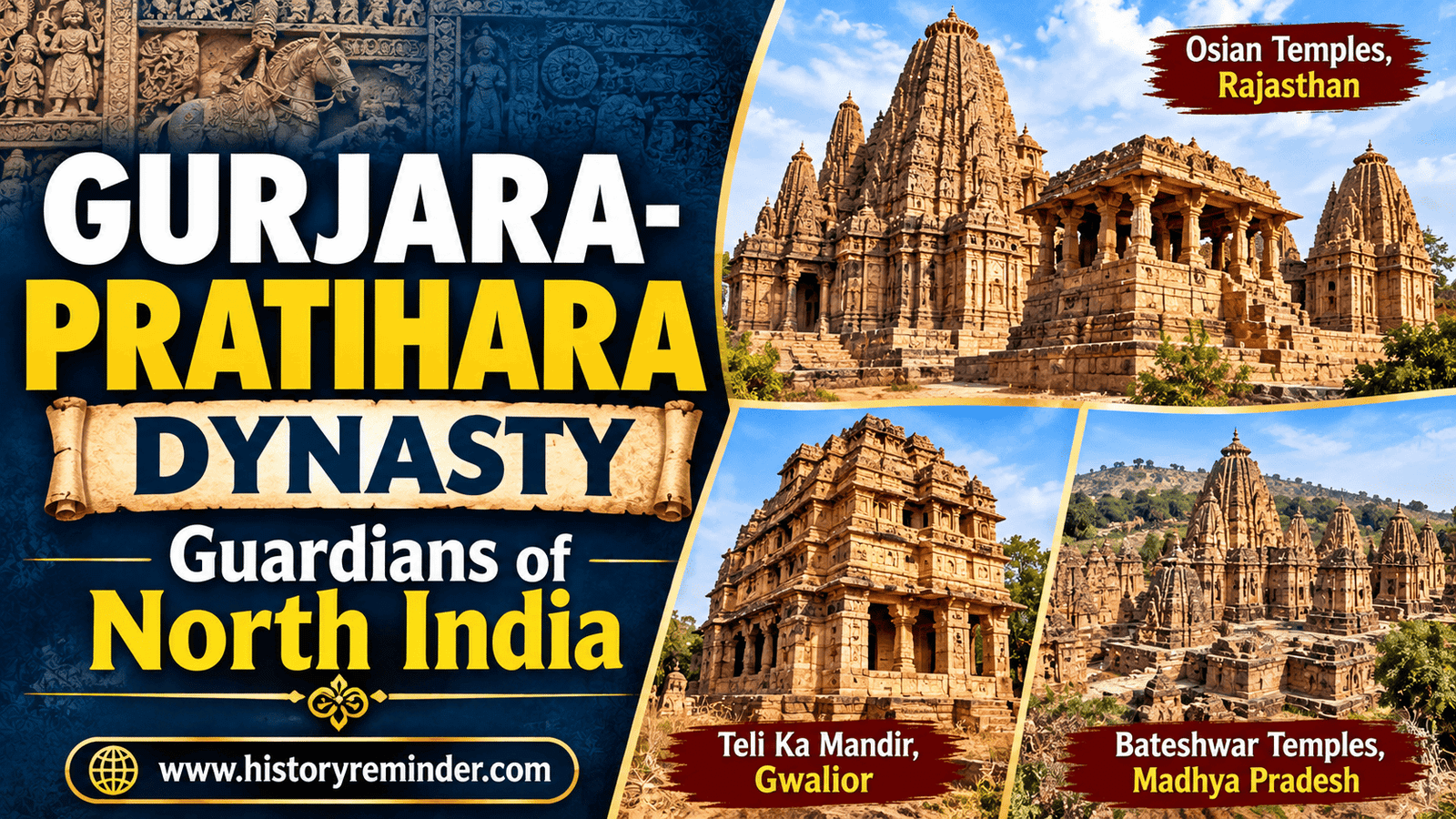
Osian Temples, Rajasthan: Osian is known for a group of early medieval temples representing the architectural traditions of western India. The temples are associated with the Pratihara period and include Hindu and Jain religious structures.
Teli Ka Mandir, Gwalior: This impressive temple at Gwalior Fort is generally associated with early medieval temple architecture. Its unusual combination of architectural features reflects the diversity of building traditions in central India.
Bateshwar Temples, Madhya Pradesh: The Bateshwar group near Morena contains numerous small sandstone temples. The complex represents the rich temple-building traditions of the early medieval period, with several structures associated with the Pratihara-era architectural environment.
Pratihara-period sculpture included representations of Hindu deities, religious symbols, decorative patterns, and figures from mythology. Stone carving and temple decoration demonstrate the skills of artisans working under royal and local patronage.
These monuments remain valuable evidence of the artistic achievements of early medieval northern India.
9. Literature and Education
Literature and scholarship also developed under Pratihara rule. Sanskrit remained an important language of political communication, religious learning, and literary production.
Rajasekhara was one of the best-known literary figures associated with the Pratihara court. He wrote works such as Kavyamimamsa, which discusses literary composition and the role of poets. His writings provide information about Sanskrit literary culture and the intellectual environment of the period.
Religious institutions and temples also supported education and scholarship. Brahmanical learning, philosophical discussions, religious literature, and traditional knowledge continued to develop across different regions.
Literary sources, together with inscriptions and archaeological remains, help historians reconstruct the intellectual life of the period.
10. Decline of the Gurjara-Pratihara Dynasty
The decline of the dynasty began gradually during the 10th century. Although the Pratiharas had established considerable political authority under rulers such as Mihira Bhoja and Mahendrapala I, maintaining a large kingdom became increasingly difficult.
Several factors contributed to the decline:
- Rashtrakuta attacks: Repeated military campaigns from the Deccan weakened Pratihara authority.
- Rise of regional powers: Local rulers and subordinate chiefs gradually became more independent.
- Weak successors: Later rulers struggled to maintain the political strength of their predecessors.
- Territorial fragmentation: The empire gradually lost control over important regions.
- External pressure: Raids and political challenges from neighbouring powers further weakened the kingdom.
By the 11th century, the Pratiharas had lost much of their earlier influence. Regional powers such as the Chahamanas, Paramaras, Chandellas, and others became increasingly important in northern and central India.
The decline of the dynasty did not mean that its cultural and architectural traditions disappeared. Many of its artistic and religious influences continued through later regional kingdoms.
11. Historical Sources of the Pratihara Period
Historians use several types of evidence to understand the rise, expansion, and decline of the Pratiharas. These sources are important because they provide information about political events, rulers, administration, religious donations, and economic conditions.
- Inscriptions: Stone inscriptions and copper-plate records provide details about rulers, land grants, victories, and administrative arrangements.
- Coins: Pratihara coins help identify royal titles, religious symbols, and aspects of the monetary system.
- Literary works: Sanskrit texts and court literature provide information about political and cultural life.
- Foreign accounts: Accounts of Arab writers, including descriptions of powerful Indian kingdoms, provide additional historical context.
- Archaeological remains: Temples, sculptures, and monuments help reconstruct the artistic and religious developments of the period.
One important example is the Gwalior inscription associated with Mihira Bhoja. It provides valuable information about the ruler and his political achievements. Such inscriptions are especially useful because they offer direct historical evidence, although royal records must still be read critically.
12. Historical Importance and Legacy
The Pratiharas occupy an important position in the political history of early medieval India. Their rise demonstrates the emergence of powerful regional kingdoms following the decline of earlier imperial structures.
They played a major role in the Tripartite Struggle, strengthened political authority over Kannauj, and contributed to the development of temple architecture and Sanskrit literature.
The dynasty also provides an important example of how regional powers used military organisation, religious patronage, land grants, and political alliances to maintain authority.
For anyone studying a history of ancient and early medieval india, the Pratiharas are essential for understanding the transition from ancient imperial systems to the regional political structures of medieval India.
Conclusion
The Gurjara-Pratihara Dynasty was one of the most influential political powers of early medieval northern India. From the early achievements of Nagabhata I to the expansion under Mihira Bhoja and Mahendrapala I, the dynasty played a significant role in shaping the political history of the subcontinent.
Its involvement in the Tripartite Struggle, administrative organisation, military strength, religious patronage, and architectural achievements made it an important part of India’s historical development.
Although the dynasty eventually declined, its contributions to temple architecture, literature, and regional politics remain significant. Studying the Pratiharas provides a deeper understanding of the political and cultural changes that shaped northern India between the 8th and 11th centuries.
Pingback: Medieval Indian History: Dynasties, Rulers, Society, Culture and Achievements - historyremindercom