

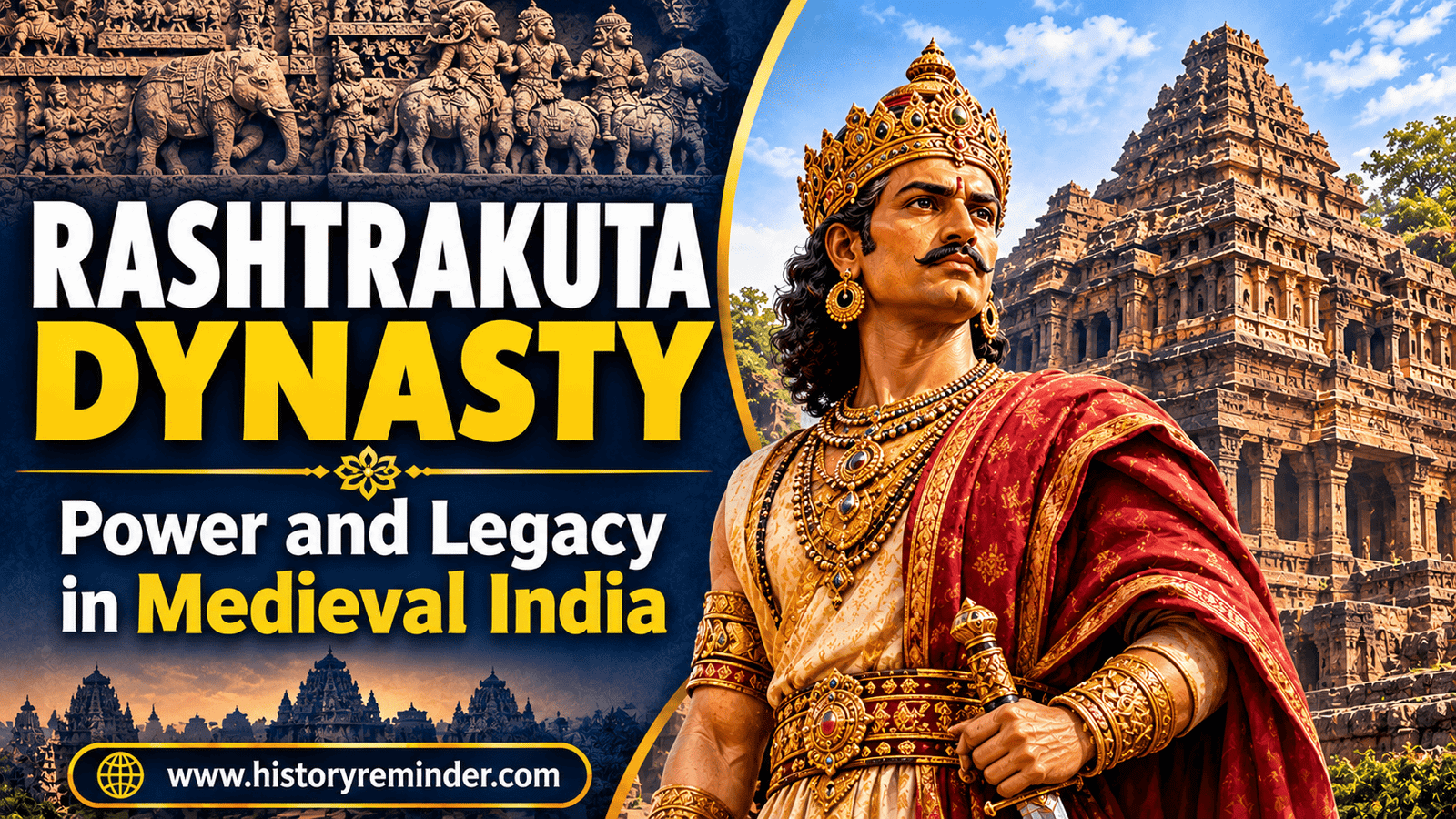
- Dynasty: Rashtrakuta
- Period: Approximately 753–973 CE
- Founder of the imperial line: Dantidurga
- Important capital: Manyakheta (modern Malkhed, Karnataka)
- Important rulers: Dantidurga, Krishna I, Govinda III, Amoghavarsha I and Krishna III
- Famous monument: Kailasa Temple, Ellora
- Major languages: Sanskrit and Kannada
Origin and Rise of the Rashtrakutas
The Rashtrakutas initially emerged as powerful local rulers in the Deccan. The word Rashtrakuta is found in early Indian inscriptions and is associated with administrative and political titles. The precise origin of the ruling family and its early history remain subjects of historical discussion.
Before establishing an independent empire, the Rashtrakutas served as important regional powers under the Badami Chalukyas. Over time, they increased their military and political influence and challenged the authority of their Chalukya overlords.
The rise of the Rashtrakuta Dynasty became significant during the eighth century when Dantidurga defeated the Badami Chalukya ruler Kirtivarman II. Around 753 CE, Dantidurga established independent authority and laid the foundation of a powerful Deccan kingdom.
Important Rulers of the Rashtrakuta Dynasty
The empire became powerful under a series of ambitious rulers. Some expanded its territories through military campaigns, while others encouraged education, literature, religion and architecture.
1. Dantidurga (c. 753 CE onwards)
Dantidurga is regarded as the founder of the imperial Rashtrakuta line. He defeated the Badami Chalukyas and established independent rule in the Deccan. His military success helped the family become one of the leading political powers of the region.
He also strengthened his position through political alliances and campaigns in neighbouring territories. Although details of his reign are limited, inscriptions provide important evidence of his growing authority.
2. Krishna I (c. 756–773 CE)
Krishna I succeeded Dantidurga and further consolidated the kingdom. He extended Rashtrakuta control over important areas and strengthened the political structure established by his predecessor.
Krishna I is particularly remembered for his association with the construction of the famous Kailasa Temple at Ellora. This extraordinary rock-cut monument is dedicated to Lord Shiva and is considered one of the finest examples of Indian rock-cut architecture.
3. Govinda III (c. 793–814 CE)
Govinda III was one of the most successful military rulers of the dynasty. He expanded the empire through campaigns in northern and southern India and strengthened Rashtrakuta influence beyond the Deccan.
His northern campaigns brought him into contact with the major powers of northern India. Historical records describe his victories over several rulers, although royal inscriptions often present military achievements in exaggerated language.
Govinda III also maintained the authority of the empire over subordinate rulers and regional chiefs. His reign represents an important phase of Rashtrakuta political and military expansion.
4. Amoghavarsha I (c. 814–878 CE)
Amoghavarsha I was one of the longest-reigning and most influential Rashtrakuta rulers. Unlike some of his predecessors, he is especially remembered for his interest in literature, religion and cultural development.
He made Manyakheta an important political and cultural centre. His reign witnessed significant developments in Kannada and Sanskrit literature. The famous Kannada literary work Kavirajamarga is traditionally associated with him and is considered one of the earliest surviving works on Kannada poetics.
Amoghavarsha I also showed an interest in Jainism and maintained relations with different religious communities. His rule is often regarded as an important period of cultural growth in the Deccan.
5. Krishna III (c. 939–967 CE)
Krishna III was among the last major powerful rulers of the dynasty. He led successful military campaigns in southern India and extended Rashtrakuta influence into parts of the Tamil region.
One of his most important achievements was his victory over the Chola forces at the Battle of Takkolam around 949 CE. This victory helped him gain influence over parts of northern Tamil country.
His reign marked the final major phase of Rashtrakuta political strength. After his death, the empire faced increasing challenges from regional powers.
The Tripartite Struggle and Northern Indian Politics
The Rashtrakutas were involved in the famous Tripartite Struggle, a long political competition for control over Kannauj in northern India. Kannauj was an important political and strategic centre, and control over it could strengthen a ruler’s prestige and influence across northern India.
The three main powers involved were:
- Rashtrakutas: The powerful rulers of the Deccan.
- Gurjara-Pratiharas: A major political power in western and northern India.
- Palas: The ruling dynasty of Bengal and Bihar.
The conflict continued through different phases under rulers such as Dhruva, Govinda III and other kings. The Rashtrakutas launched campaigns into northern India and temporarily established their influence over Kannauj. However, no single power maintained permanent control over the city for a long period.
The Tripartite Struggle is important because it shows how political authority in early medieval India was shaped by military campaigns, regional alliances and competition among powerful dynasties.
Administration of the Rashtrakuta Empire
The Rashtrakuta rulers developed an administrative system that allowed them to govern a large empire with different languages, communities and regional traditions. The king was the highest authority and was responsible for military leadership, administration and major political decisions.
Central Administration
The king was assisted by ministers, officials and military commanders. Important administrative positions were often held by members of influential families. The royal court played an important role in managing political affairs and maintaining relations with subordinate rulers.
Provincial Administration
The empire was divided into administrative units, which were governed by officials and regional authorities. Local chiefs and subordinate rulers often retained considerable control over their territories while accepting the authority of the emperor.
This arrangement helped the rulers govern distant regions, but it also meant that the central government depended on the loyalty of powerful local families.
Revenue System
Agriculture was the main foundation of the economy. Land revenue formed an important source of state income. Taxes were collected from agricultural production, trade and other economic activities.
Land grants were also common. Rulers donated land to religious institutions, temples, Brahmanas and other beneficiaries. These grants helped support religious and educational activities while strengthening relationships between the royal court and local communities.
Military Organisation and Expansion
The Rashtrakuta army was an important instrument of imperial expansion. It included infantry, cavalry and war elephants. Cavalry played a particularly important role in campaigns across the Deccan and northern India.
The rulers also depended on military support from subordinate chiefs and regional allies. These relationships helped them conduct campaigns over large distances and maintain authority in different parts of the empire.
Military campaigns against the Cholas, Pallavas, Gurjara-Pratiharas and other regional powers demonstrate the wide political influence of the dynasty. However, frequent warfare also placed pressure on resources and sometimes weakened central authority.
Art and Architecture: The Kailasa Temple at Ellora
One of the greatest contributions of the Rashtrakuta Dynasty was its support for art and architecture. The rulers encouraged the construction of temples, religious monuments and rock-cut structures that reflected the artistic skills of the period.
Kailasa Temple, Ellora
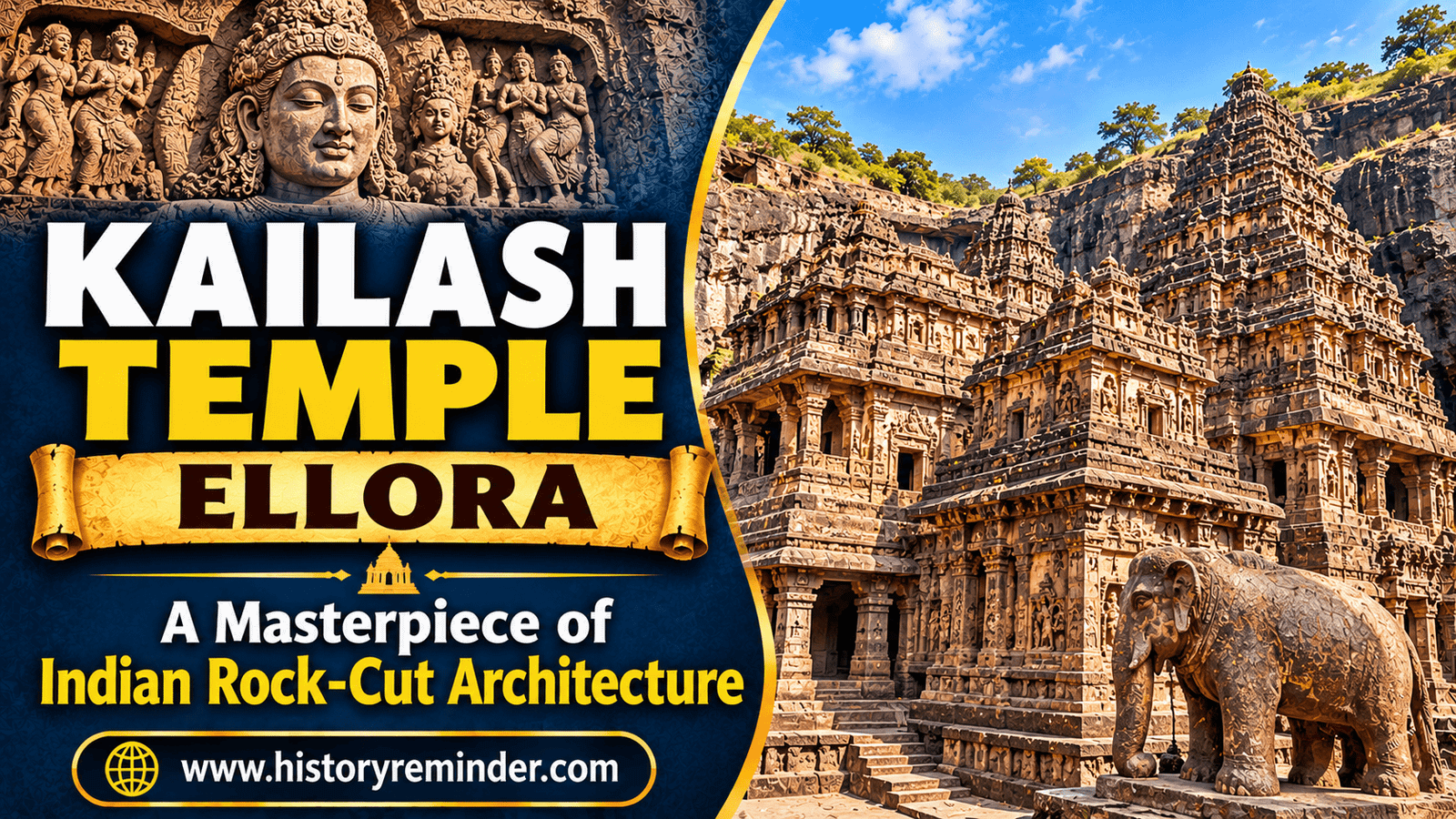
The Kailasa Temple, located at Ellora in present-day Maharashtra, is the most famous architectural monument associated with the Rashtrakutas. It is generally attributed to the reign of Krishna I and is dedicated to Lord Shiva.
The temple was carved from a single mass of rock and is an extraordinary example of monolithic architecture. Unlike structures built by joining separate stones, the monument was created by cutting and removing rock from the surrounding hillside.
Its design includes a large courtyard, a gateway, a Nandi pavilion, a central shrine and detailed sculptural panels. The carvings depict scenes from Hindu mythology, including stories associated with Shiva and Vishnu.
The Kailasa Temple demonstrates the advanced engineering knowledge, artistic creativity and organisational ability of the craftsmen of the period.
Other Architectural Contributions
The rulers and their subjects supported several religious and architectural traditions. Ellora contains Hindu, Buddhist and Jain monuments, reflecting the religious diversity of the region. The wider artistic environment of the Deccan included rock-cut caves, structural temples and elaborate sculptures.
Religion and Religious Tolerance
The Rashtrakuta rulers supported different religious traditions, including Hinduism, Jainism and Buddhism. Their religious policies were not limited to one faith, and inscriptions and monuments provide evidence of patronage extended to different communities.
Some rulers showed particular interest in Jainism. Amoghavarsha I, for example, is associated with Jain teachers and religious traditions. At the same time, Hindu temples and religious institutions received royal and local support.
This diversity contributed to the cultural richness of the Deccan. Religious institutions also played an important role in education, land management, literature and artistic production.
Literature and Education
The Rashtrakuta period was an important phase in the development of Kannada and Sanskrit literature. Royal patronage encouraged poets, scholars and religious teachers to produce literary and philosophical works.
Kannada Literature
Kavirajamarga, traditionally associated with Amoghavarsha I and the poet Sri Vijaya, is an important early work on Kannada literature and poetics. It discusses literary style, language and the qualities of poetry.
Other important Kannada writers associated with the wider Rashtrakuta period include Adikavi Pampa, Sri Ponna and Ranna. Their works helped establish a strong literary tradition in the Deccan.
Sanskrit Literature
Sanskrit continued to be an important language of scholarship, religious writing and royal inscriptions. Scholars produced works on philosophy, grammar, literature and religion. The use of both Sanskrit and Kannada reflects the multilingual cultural environment of the empire.
Economy, Agriculture and Trade
Agriculture was the main source of livelihood for most people. The Deccan region supported the cultivation of crops such as rice, millet and pulses, depending on local soil and rainfall conditions.
Trade and crafts also contributed to the prosperity of the empire. Merchants, artisans and trading organisations connected towns and rural settlements. Trade routes linked the Deccan with western coastal ports and other parts of India.
Commercial activity included the exchange of textiles, metal goods, agricultural products and other commodities. Merchant groups and local trading communities played an important role in regional economic life.
Decline of the Rashtrakuta Dynasty
After the death of Krishna III in 967 CE, the empire gradually lost its political strength. Later rulers faced internal disputes, pressure from subordinate chiefs and challenges from neighbouring powers.
The Western Chalukyas, under Tailapa II, emerged as a major challenge. Around 973 CE, Tailapa II defeated the last Rashtrakuta ruler, Karka II, and established the power of the Western Chalukyas in the Deccan.
The fall of the Rashtrakuta Dynasty marked the end of an important phase in Deccan history. However, its political, literary and architectural influence continued through later regional kingdoms.
Historical Sources for Studying the Rashtrakutas
Historians use inscriptions, literary works, coins and archaeological remains to understand the history of the Rashtrakutas. These sources provide information about rulers, administration, religious patronage, land grants and military campaigns.
- Inscriptions: Copper-plate and stone inscriptions provide details about royal achievements, land grants and administration.
- Literary works: Texts such as Kavirajamarga offer evidence of literary and cultural developments.
- Architecture: The Kailasa Temple and other monuments at Ellora reveal the artistic and technical achievements of the period.
- Coins: Numismatic evidence can help historians study political authority and economic activity.
Each source has limitations. Royal inscriptions, for example, often praise rulers and describe victories in grand language. Historians compare different types of evidence to develop a more balanced understanding of the period.
Historical Importance and Legacy
The Rashtrakuta Dynasty occupies an important place in the history of early medieval India. Its rulers established a powerful empire in the Deccan and influenced political developments in both northern and southern India.
The dynasty’s contribution to architecture is especially significant. The Kailasa Temple at Ellora remains a remarkable example of Indian rock-cut engineering and artistic excellence. Its support for Kannada and Sanskrit literature also helped strengthen the intellectual traditions of the region.
The Rashtrakutas further contributed to the cultural diversity of the Deccan by supporting different religious communities and institutions. Their history provides valuable insight into the political, economic and cultural developments of early medieval India.
Frequently Asked Questions (FAQs)
Who founded the Rashtrakuta Dynasty?
Dantidurga is recognised as the founder of the imperial Rashtrakuta line. He established independent rule after defeating the Badami Chalukyas around 753 CE.
What was the capital of the Rashtrakutas?
Manyakheta, located in present-day Malkhed in Karnataka, became the major capital of the empire.
Who built the Kailasa Temple at Ellora?
The Kailasa Temple is generally attributed to the reign of Krishna I, although its construction and artistic development may have involved work over time.
Who was the most famous Rashtrakuta ruler?
Amoghavarsha I was one of the most famous rulers because of his long reign and contributions to literature and culture. Govinda III and Krishna III were also important military rulers.
What was the Tripartite Struggle?
It was a political competition among the Rashtrakutas, Gurjara-Pratiharas and Palas for influence over Kannauj in northern India.
When did the Rashtrakuta Empire decline?
The empire ended around 973 CE when Tailapa II of the Western Chalukya line defeated Karka II and established a new ruling power in the Deccan.
References and Further Reading
- Archaeological Survey of India – Information about Indian monuments and archaeological heritage.
- UNESCO – Ellora Caves – Historical and architectural information about the Ellora monument complex.
- Encyclopaedia Britannica – Background reading on Indian history and the Deccan.
Pingback: Medieval Indian History: Dynasties, Rulers, Society, Culture and Achievements - historyremindercom