

The history of ancient India witnessed a major political and social transformation around the sixth century BCE. Small settlements gradually developed into powerful kingdoms and republics known as the Mahajanapadas. These states played an important role in shaping India’s political institutions, economy, trade, cities, and religious traditions.
Introduction to the Mahajanapadas
The term Mahajanapada comes from two Sanskrit words: Maha, meaning great, and Janapada, meaning a territory where a group of people had settled. As populations increased and agricultural communities expanded, several smaller Janapadas grew into larger political units.
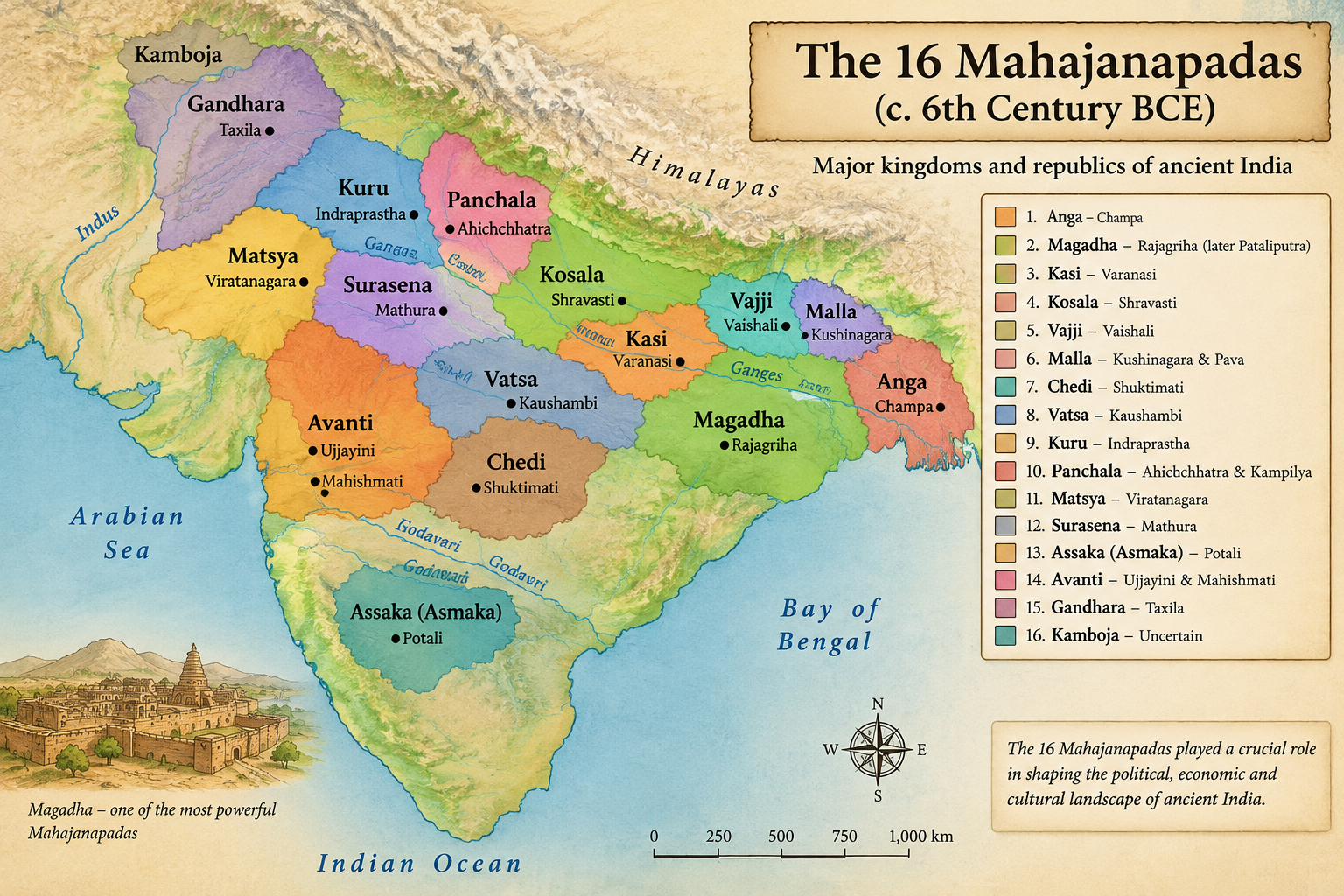
According to early Buddhist literature, particularly the Anguttara Nikaya, there were 16 Mahajanapadas during this period. These states extended across different parts of the Indian subcontinent, from the northwest to the Ganga plains and the Deccan.
Studying the Mahajanapadas helps us understand how ancient Indian society moved towards organised states, developed new economic systems, and created the political foundations for later empires.
Historical Background: The Rise of the Mahajanapadas
The emergence of the Mahajanapadas was closely connected with changes in agriculture, technology, population, and trade. During the later Vedic period, communities increasingly settled in permanent agricultural territories. Some settlements gradually expanded and developed stronger political institutions.
Factors Behind Their Rise
- Agricultural development: Fertile land, particularly in the Ganga plains, supported food production. Agricultural surplus helped rulers collect taxes and maintain armies.
- Use of iron: Iron tools supported land clearance and agricultural activities in suitable regions. Iron weapons also contributed to military strength.
- Expansion of trade: Traders connected settlements through regional routes. Growing trade encouraged markets, towns, and specialised occupations.
- Growth of cities: Important settlements became administrative and commercial centres. Fortifications helped protect some capitals.
- Changing political systems: Some states developed hereditary monarchies, while others followed collective systems of governance known as gana-sanghas.
This period is also associated with the Second Urbanisation of the Indian subcontinent, a major phase of urban growth following the earlier Harappan civilisation.
What Were the 16 Mahajanapadas?
The 16 Mahajanapadas were major political territories mentioned in early Buddhist and Jain literature. Historians compare these literary accounts with archaeological discoveries to understand their capitals, boundaries, and political development.
The traditional list includes Anga, Magadha, Kasi, Kosala, Vajji, Malla, Chedi, Vatsa, Kuru, Panchala, Matsya, Surasena, Assaka, Avanti, Gandhara, and Kamboja.
List of the 16 Mahajanapadas and Their Capitals
| No. | Mahajanapada | Associated Capital | Approximate Modern Region |
|---|---|---|---|
| 1 | Anga | Champa | Eastern Bihar |
| 2 | Magadha | Rajagriha | Southern Bihar |
| 3 | Kasi | Varanasi | Eastern Uttar Pradesh |
| 4 | Kosala | Shravasti | Awadh region, Uttar Pradesh |
| 5 | Vajji | Vaishali | Northern Bihar |
| 6 | Malla | Kushinagara and Pava | Eastern Uttar Pradesh |
| 7 | Chedi | Shuktimati | Parts of Bundelkhand |
| 8 | Vatsa | Kaushambi | Near Prayagraj, Uttar Pradesh |
| 9 | Kuru | Indraprastha | Delhi and adjoining regions |
| 10 | Panchala | Ahichchhatra and Kampilya | Uttar Pradesh |
| 11 | Matsya | Viratanagara | Parts of Rajasthan |
| 12 | Surasena | Mathura | Mathura region, Uttar Pradesh |
| 13 | Assaka (Asmaka) | Potali in some traditions | Godavari valley |
| 14 | Avanti | Ujjayini and Mahishmati | Madhya Pradesh |
| 15 | Gandhara | Taxila | Parts of Pakistan and Afghanistan |
| 16 | Kamboja | Uncertain | Northwestern subcontinent |
Important Mahajanapadas and Their Historical Significance
Although all the Mahajanapadas contributed to early state formation, some became particularly influential because of their political power, trade networks, or cultural importance.
1. Magadha
Magadha emerged as one of the most powerful Mahajanapadas between the sixth and fourth centuries BCE. It occupied a strategic position in present-day Bihar, with access to fertile agricultural land, river routes, and nearby iron resources.
Its early capital was Rajagriha, identified with modern Rajgir. Later, Pataliputra, near present-day Patna, became an important political centre. Rulers such as Bimbisara and Ajatashatru expanded Magadha’s influence through political alliances and military campaigns.
Magadha’s geographical advantages, agricultural resources, and ambitious rulers helped it overcome rival states. Eventually, it became the foundation for larger imperial powers, including the Mauryan Empire.
2. Kosala
Kosala was an important Mahajanapada located mainly in the Awadh region of present-day Uttar Pradesh. Shravasti was an important capital, while Ayodhya also held considerable significance in the region’s traditions.
Kosala frequently competed with neighbouring states, particularly Kasi and Magadha. Its political influence and agricultural resources made it one of the leading powers of the period.
3. Vatsa
Vatsa was centred around Kaushambi, an important settlement near present-day Prayagraj in Uttar Pradesh. Its location supported communication and commercial connections with other regions.
King Udayana is traditionally associated with Vatsa. Its history demonstrates how control over trade routes and urban centres could strengthen a Mahajanapada.
4. Avanti
Avanti was a powerful state in present-day Madhya Pradesh. Its two important centres were Ujjayini and Mahishmati. Ujjayini developed into an important centre for trade and communication between northern and southern regions.
Avanti competed with Magadha for political influence. Its geographical position and commercial connections made it an important power in central India.
5. Vajji
Vajji, also written as Vrijji, was known for its collective political system. Vaishali was an important centre associated with the confederacy, which included the Licchavis and other groups.
Unlike a conventional hereditary monarchy, a gana-sangha involved decision-making by an assembly of leading members. However, these systems should not be confused with modern democratic governments because political participation was limited and unequal.
The example of Vajji shows that the Mahajanapadas had different approaches to governance.
Political Systems of the Mahajanapadas
One important feature of the Mahajanapadas was the coexistence of monarchies and non-monarchical political systems.
Monarchies
In states such as Magadha, Kosala, Vatsa, and Avanti, kings exercised substantial political authority. They collected taxes, organised armies, managed administration, and expanded their territories.
Gana-sanghas
In states such as Vajji and Malla, political authority was exercised collectively by groups of influential members. Assemblies played an important role in decision-making.
These systems reflect the growing complexity of ancient Indian society. Larger populations and expanding economic activities required organised methods of collecting resources, maintaining security, and managing territories.
The Mahajanapada period was not only an age of political competition. It was also a time of significant economic and social change.
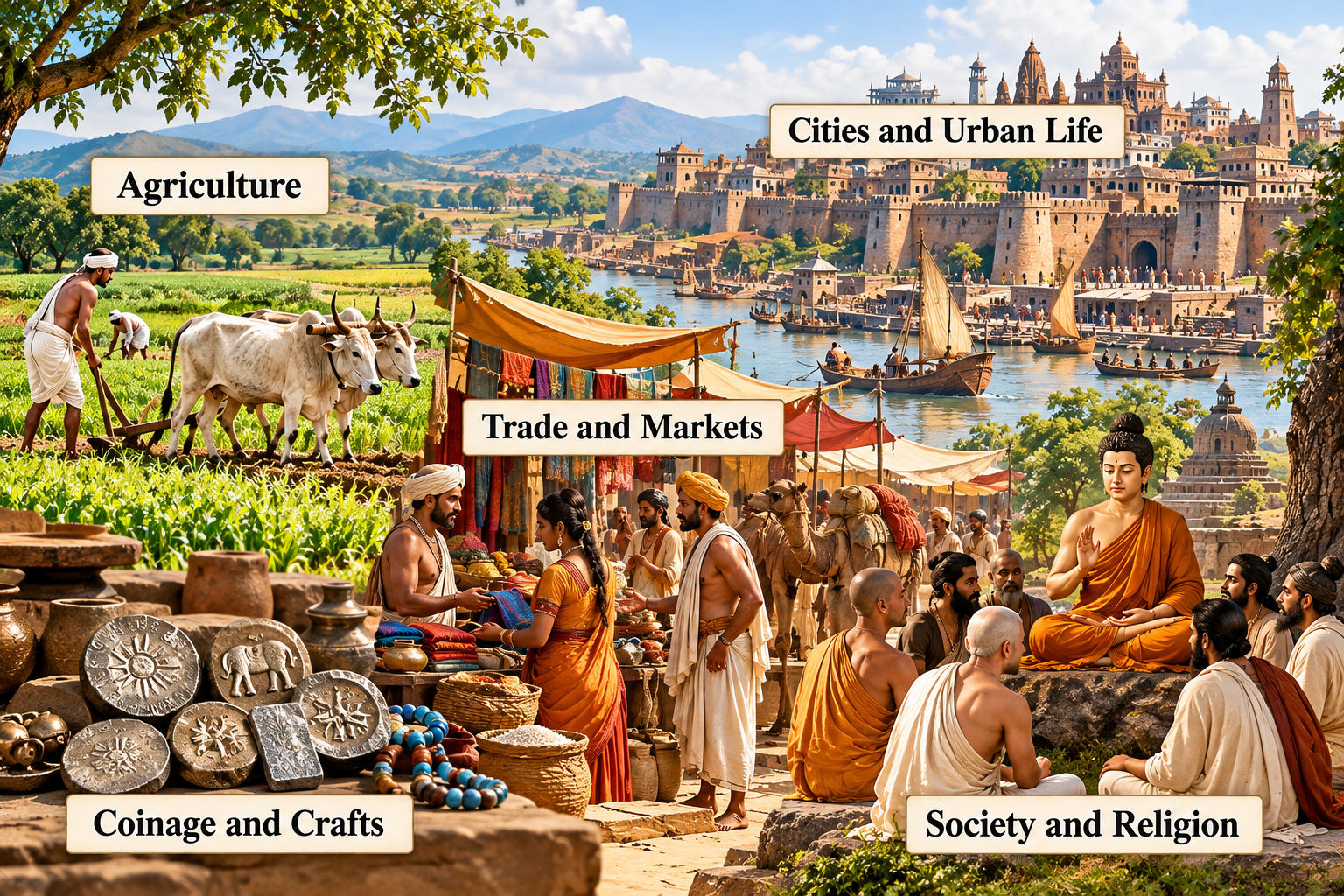
Agriculture formed the foundation of many states. Farmers produced food that supported growing populations, urban centres, soldiers, and administrative officials. Rulers collected taxes and other resources to maintain their governments.
Trade also expanded during this period. Merchants transported agricultural products, crafts, and other goods between settlements. Important towns developed into commercial centres, connecting different regions.
Another important development was the use of early coinage, including punch-marked coins. Their archaeological remains provide evidence of changing economic practices, although the use of coins varied across places and periods.
Craft production, including metalworking and pottery, supported the growth of towns. Archaeological evidence, including Northern Black Polished Ware found at several early historic sites, helps historians investigate urban development and material culture.
The expansion of cities also created new social and occupational groups. Merchants, artisans, agricultural communities, rulers, and religious teachers all contributed to changing social relationships.
The Mahajanapadas and the Rise of Buddhism and Jainism
The sixth century BCE was an important period in the development of new religious and philosophical traditions. Buddhism, associated with Gautama Buddha, and Jainism, associated with Mahavira, gained prominence in this wider historical setting.
Many regions associated with these traditions were located in the Ganga plains, where urban settlements, trade, and political competition were expanding.
Growing towns brought together people from different occupations and social backgrounds. Merchants and other urban groups became important participants in religious communities. Teachings that addressed ethical conduct, suffering, self-discipline, and liberation attracted followers.
Both the Buddha and Mahavira are associated with the wider gana-sangha world, although their teachings should not be understood simply as products of one political system.
Buddhist and Jain texts are valuable historical sources because they preserve information about rulers, cities, rivalries, and religious communities. Historians examine these texts critically and compare them with archaeological evidence because literary traditions may differ in their details.
Why Did Magadha Become the Most Powerful Mahajanapada?
The rise of Magadha is one of the most important developments in ancient Indian history. Several factors explain its growing strength.
- Fertile agricultural land: Productive agricultural areas supported food production and taxation.
- Access to iron: Iron resources helped provide materials for tools and weapons.
- Elephants and forests: Forests supplied elephants, which were valuable in ancient warfare.
- River routes: The Ganga and its tributaries provided routes for communication and trade.
- Effective leadership: Ambitious rulers used military organisation, expansion, and political alliances to strengthen the kingdom.
Bimbisara strengthened the kingdom through expansion and alliances, while Ajatashatru continued its struggle for regional supremacy. Over time, Magadha absorbed or defeated rival powers and became the centre of a larger political formation.
Under the Nandas and later the Mauryas, the region played a major role in the development of imperial rule. The rise of Magadha demonstrates that geographical advantages alone did not determine political success. Resources, military organisation, diplomacy, and leadership worked together to shape the outcome.
Mahajanapadas in the Ancient History Timeline
Understanding the Mahajanapadas becomes easier when they are placed within a broader ancient history timeline.
Later Vedic period: Agricultural settlements and territorial communities expanded in parts of northern India.
Around the eighth to sixth centuries BCE: Some Janapadas developed into larger political units, although the timing differed by region.
Around the sixth century BCE: The Mahajanapadas became prominent alongside urban growth, coinage, and new religious traditions.
Sixth to fourth centuries BCE: Magadha expanded its influence and emerged as a dominant power.
Fourth century BCE: The Nanda dynasty ruled Magadha before the rise of the Mauryan Empire.
Late fourth century BCE: Chandragupta Maurya established the Mauryan Empire, creating a much larger political structure.
These dates are approximate and describe broad historical developments rather than exact starting and ending points for every state.
Conclusion
The Mahajanapadas represent a major turning point in the history of ancient India. Their emergence reflects the growth of agriculture, trade, cities, taxation, and organised political institutions.
The 16 Mahajanapadas were not identical kingdoms. Some followed monarchies, while others developed collective forms of governance. Their competition shaped regional politics, and the eventual rise of Magadha created the foundation for the Mauryan Empire.
For students exploring the ancient history timeline, the Mahajanapadas provide an essential link between the later Vedic period and the emergence of large territorial empires. Studying their capitals, political systems, economic activities, and religious connections offers a clearer understanding of how early Indian society changed over time.
Pingback: Ancient History Of India Timeline: A Complete Guide. - historyremindercom