

The Vedic period is one of the most important phases in the development of early Indian civilisation. It is associated with the composition and transmission of the Vedas, the earliest surviving Sanskrit literature of South Asia, and with major changes in society, economy, religion and political organisation. Historians generally discuss the Vedic period from roughly the second millennium BCE to the middle of the first millennium BCE, although exact dates remain debated because literary traditions and archaeological cultures do not always fit into a single chronological framework.
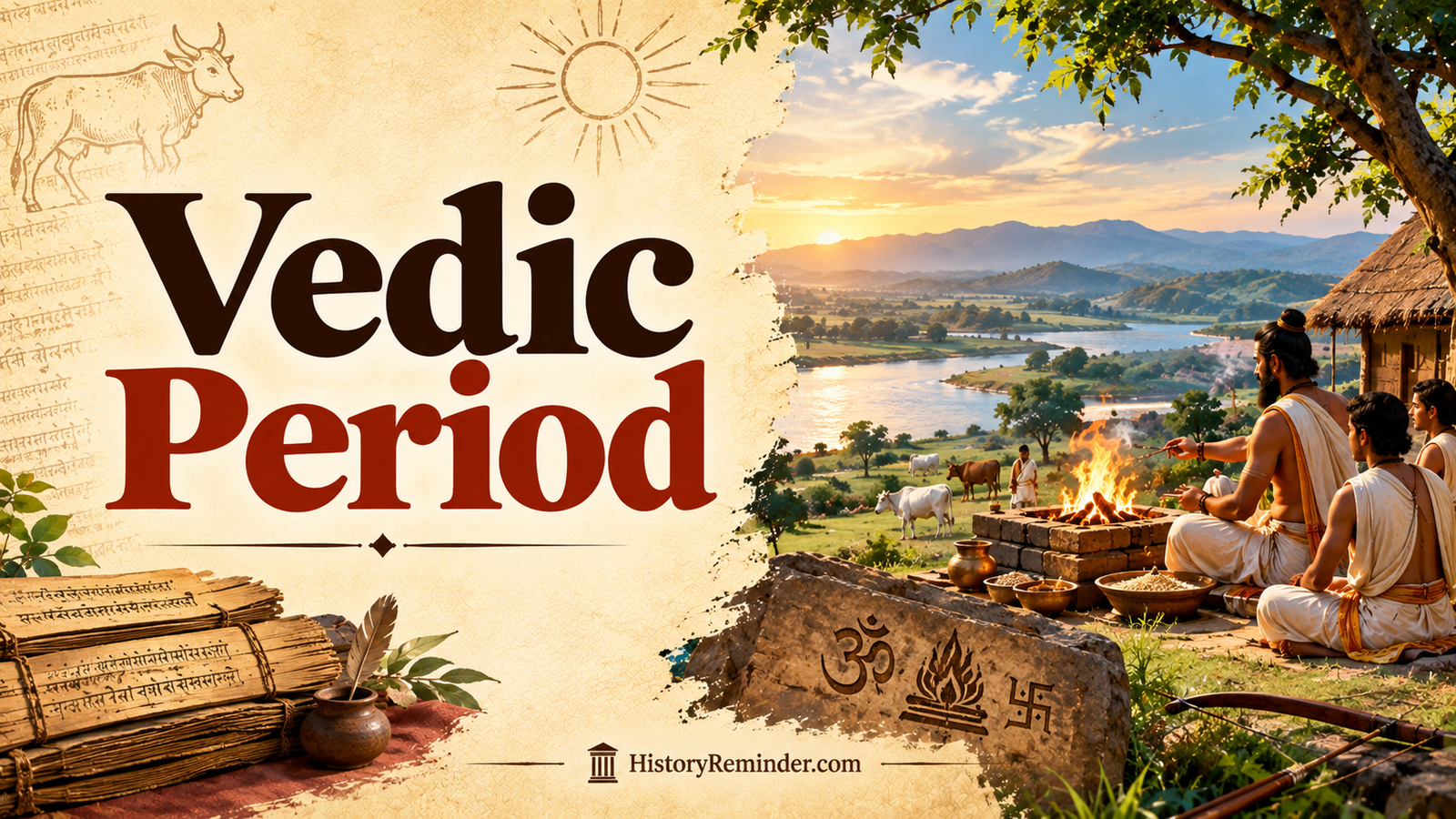
The Vedic period is usually divided into the Early Vedic period and the Later Vedic period. The Early Vedic period is primarily associated with the Rigveda and communities located largely in the northwestern part of the Indian subcontinent. Over time, Vedic culture expanded eastward toward the Ganga-Yamuna region, while agriculture, iron technology, territorial kingdoms and more complex social institutions became increasingly important.
Understanding the Vedic period is essential for students studying the ancient history timeline of India because it connects the post-Harappan world with the political, social and intellectual developments that eventually contributed to the emergence of early states and the second urbanisation.
What Is the Vedic Period?
The Vedic period gets its name from the four Vedas: the Rigveda, Samaveda, Yajurveda and Atharvaveda. These texts contain hymns, chants, ritual instructions, prayers and other forms of knowledge that developed through a long oral tradition.
The Rigveda is generally considered the earliest of the four Vedas. Its hymns provide information about gods, rituals, rivers, communities, warfare, cattle, agriculture and social relationships. However, historians do not treat the Vedas as straightforward historical chronicles. They are religious and literary texts, so their evidence must be interpreted alongside archaeology, linguistics and other sources.
The Early Vedic period is particularly associated with the Rigvedic tradition. Its geographical setting is concentrated mainly around the Punjab and adjoining parts of northern India, extending toward the Ganga-Yamuna confluence.
Early Vedic Period: Society and Political Life
The Early Vedic period was characterised by communities in which pastoralism played an important role. Cattle were economically valuable and were closely connected with wealth and social status. At the same time, agriculture was also practised, and the economy should not be understood as purely pastoral.
Political organisation during the Early Vedic period was comparatively less centralised than that of the territorial kingdoms that emerged later. The Rigvedic texts refer to groups, chiefs and assemblies. Terms such as sabha and samiti are commonly discussed in connection with collective decision-making, although their exact functions remain subjects of scholarly interpretation.
The chief, often described as a rajan, depended on relationships with his community rather than ruling a highly centralised bureaucratic state. Conflicts between groups could involve cattle, territory and resources.
The Early Vedic period therefore represents a society in transition, in which kinship, pastoral wealth, agriculture, warfare and religious institutions were closely connected.
Religion During the Vedic Period
Religion was central to the Vedic period. The Vedic hymns describe numerous deities associated with natural forces, social ideals and cosmic order.
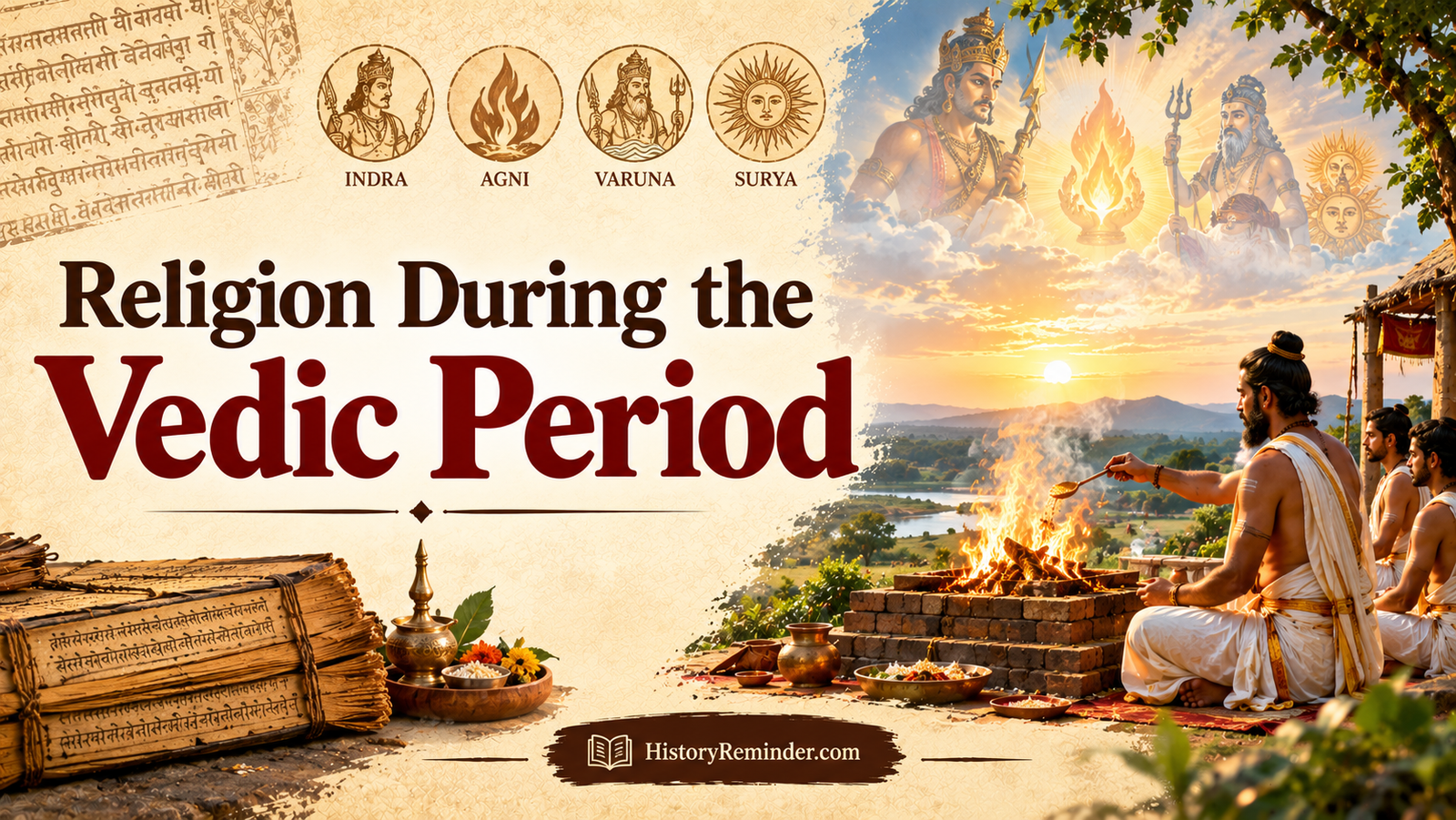
- Indra – associated with warfare, storms and victory.
- Agni – the sacred fire and an important link between humans and gods.
- Soma – associated with a ritual drink and divine power.
- Varuna – associated with cosmic and moral order.
- Surya – associated with the sun.
- Ushas – associated with the dawn.
- Vayu – associated with wind.
Sacrificial rituals were particularly important. Offerings were made through sacred fire, and priests played an increasingly significant role in performing complex rituals.
During the Early Vedic period, religious practices were strongly connected with hymns, offerings and appeals for prosperity, protection, cattle, rain and victory. In the Later Vedic phase, rituals became more elaborate and the role of specialised priests increased.
Society and the Varna System
The social structure of the Vedic period changed considerably over time. Early Vedic society appears to have been less rigidly stratified than the society described in later Vedic texts.
The four-fold varna classification—Brahmana, Kshatriya, Vaishya and Shudra—became more prominent in later Vedic literature. The famous Purusha Sukta of the Rigveda contains a four-part social classification, but historians debate its date and significance within the development of the social system.
During the Later Vedic period, social distinctions became increasingly formalised. Brahmanas were associated with ritual knowledge, Kshatriyas with political and military authority, Vaishyas with productive and economic activities, and Shudras occupied a subordinate position.
It is important, however, not to project the fully developed caste system of much later Indian history directly onto the earliest Vedic communities.
Economy: From Pastoralism to Agriculture
One of the major transformations during the Vedic period was the increasing importance of agriculture.
The Early Vedic period placed considerable emphasis on cattle and pastoral wealth, but agricultural activities were also present. Over time, settlement patterns changed and cultivation became increasingly important, especially as communities expanded toward the fertile Ganga-Yamuna plains.
The Later Vedic period saw greater use of iron technology in parts of northern India. Archaeological traditions associated with the period include Painted Grey Ware (PGW), although scholars caution against treating PGW as a simple one-to-one archaeological equivalent of the Vedic people.
The spread of agriculture supported larger settlements and contributed to the development of more powerful territorial communities.
Later Vedic Period and the Rise of Kingdoms
The Later Vedic period witnessed major political and geographical changes. Vedic traditions became increasingly associated with the western Ganga-Yamuna region and the Kuru-Panchala area.
The political structure gradually moved toward territorial kingdoms. Communities were no longer organised only around relatively small tribal groups; larger political units became increasingly significant.
Kingship became more powerful, while elaborate royal rituals helped reinforce political authority. Rituals such as the Rajasuya and Ashvamedha are discussed in later Vedic literature as important ceremonies associated with royal power.
The Later Vedic period therefore marks an important stage in the development of political institutions that would eventually contribute to the rise of the Mahajanapadas.
Vedic Literature and Oral Tradition
One of the most remarkable features of the Vedic period is the preservation of its literature through oral transmission.
The Vedas were transmitted from teacher to student through highly controlled methods of recitation. Different patterns of recitation helped preserve the pronunciation, sequence and sound of the Sanskrit text.
The four Vedas developed alongside other bodies of literature, including the Brahmanas, Aranyakas and Upanishads. These works reflect changing approaches to ritual, philosophy and knowledge.
The importance of oral transmission remains evident in modern scholarship. Recent computational research has also explored the structure and thematic relationships of the Rigveda, demonstrating how modern analytical methods can contribute to the study of ancient texts.
Education and Intellectual Development
Education during the Vedic period was closely connected with oral learning. Students traditionally learned through memorisation, repetition, recitation and instruction from teachers.
Vedic learning was not limited to religious rituals. Over time, the intellectual traditions associated with Vedic literature developed discussions concerning language, ritual, cosmology, philosophy and the nature of reality.
The Upanishads, although belonging to the later part of the broader Vedic literary tradition, introduced increasingly philosophical questions about the self, reality, knowledge and ultimate existence. These ideas became highly influential in the development of Indian philosophical traditions.
Women in Vedic Society
The position of women during the Vedic period requires careful historical interpretation because the available evidence is primarily textual and represents particular social and ritual contexts.
Some early Vedic hymns are associated with women, and later traditions remember figures such as Gargi and Maitreyi as participants in philosophical discussions. At the same time, later Vedic literature reflects increasing restrictions and stronger patriarchal structures in several aspects of social life.
Therefore, the status of women cannot be described as completely uniform throughout the Vedic period. It changed across regions, communities and chronological phases.
Archaeology and the Vedic Period
Archaeology provides an important but complex source for studying the Vedic period. Unlike inscriptions from later historical periods, Vedic literature does not provide precise dates for every event it describes.
Archaeologists therefore examine settlements, pottery, tools, agricultural remains, animal bones and metal objects alongside textual evidence.
The Painted Grey Ware tradition is especially important in discussions of the Later Vedic period. It is concentrated in parts of the Indo-Gangetic region and is associated chronologically with the first millennium BCE. However, archaeological cultures should not automatically be equated with particular linguistic or ethnic groups.
This combination of textual and archaeological evidence allows historians to construct a more balanced understanding of the period.
Vedic Period Timeline
| Period | Approximate Phase | Major Features |
|---|---|---|
| Early Vedic Period | c. 1500–1000 BCE* | Rigveda, pastoral communities, early agriculture and tribal political organisation |
| Later Vedic Period | c. 1000–600 BCE* | Agricultural expansion, iron use, territorial kingdoms and complex rituals |
| Post-Vedic Transition | After c. 600 BCE | Mahajanapadas, urbanisation and new religious-philosophical movements |
*These dates are broad conventional ranges and should not be treated as fixed dates for every Vedic text or archaeological culture. Chronologies remain an area of scholarly discussion.
Why the Vedic Period Matters
The Vedic period occupies a crucial position in Indian history because many institutions and intellectual traditions developed or transformed during this era.
It witnessed the growth of agriculture, changing settlement patterns, evolving political structures, increasingly complex social organisation and the development of influential religious and philosophical traditions.
The Early Vedic period provides an important window into communities whose economy, politics and religious practices were significantly different from those of later territorial kingdoms. The transition into the Later Vedic period shows how these communities changed as agriculture expanded and political territories became more important.
For anyone studying the ancient history timeline of India, the Vedic period is therefore an essential bridge between the post-Harappan world and the emergence of the Mahajanapadas and the early historic period.
Conclusion
The Vedic period was not a single uniform age but a long and changing phase of South Asian history. The Early Vedic period was closely associated with the Rigvedic tradition, pastoral wealth, smaller political communities and a distinctive religious culture. The Later Vedic phase witnessed expanding agriculture, changing settlement patterns, greater political centralisation, more elaborate rituals and the emergence of territorial kingdoms.
The study of the Vedic period continues to evolve as historians combine literary analysis, archaeology, linguistics and new digital research methods. Modern computational studies of the Rigveda demonstrate that even very old texts can be examined through new analytical techniques.
Rather than viewing the Vedic period simply as a list of kings, gods and dates, it is more useful to understand it as a period of significant social and cultural transformation. Its literature, ideas, political developments and religious traditions became deeply influential in the subsequent history of the Indian subcontinent.
Pingback: Ancient History Of India Timeline: A Complete Guide. - historyremindercom