

Introduction to the Mauryan Empire
The Mauryan Empire was one of the largest and most influential empires in ancient Indian history. It emerged in the fourth century BCE and brought a large part of the Indian subcontinent under a centralised political system. The empire is remembered for its powerful rulers, efficient administration, economic development, military strength, and contributions to art, architecture, and religion.
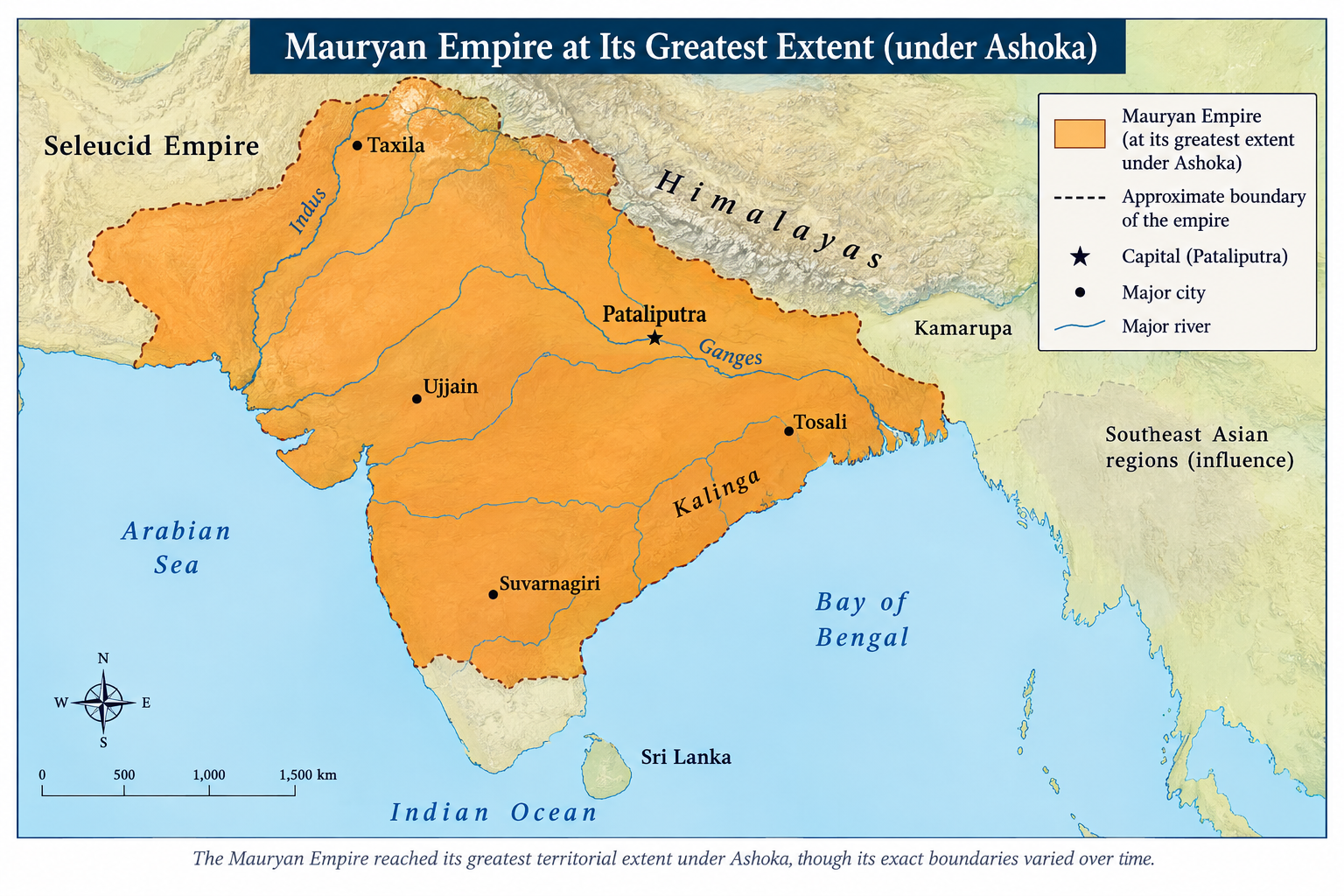
The history of the Mauryan Empire began around 322 BCE when Chandragupta Maurya established his rule after overthrowing the Nanda dynasty of Magadha. With guidance traditionally associated with Chanakya, also known as Kautilya, Chandragupta built a strong state that expanded across northern India and beyond.
The empire reached its greatest territorial extent under Ashoka, Chandragupta’s grandson. Ashoka is especially remembered for his transformation after the Kalinga War and his efforts to promote Dhamma, moral conduct, and religious tolerance. Studying the Mauryan period helps readers understand the political and cultural foundations of ancient India.
1. Rise and Foundation of the Maurya Dynasty
The Maurya dynasty arose during a period of political competition among the kingdoms and republics of northern India. Magadha, located in present-day Bihar, had become a powerful centre because of its agricultural resources, access to rivers, iron resources in nearby regions, and expanding trade networks.
Before the Mauryas, the Nanda dynasty controlled Magadha. According to traditional accounts, Chandragupta Maurya challenged Nanda authority and established a new ruling dynasty around 322 BCE. Ancient literary sources, including Buddhist, Jain, and later Sanskrit traditions, preserve different accounts of his rise.
The foundation of the Chandragupta Maurya Empire marked an important stage in the development of large-scale political organisation in India. Chandragupta expanded his authority across much of northern India and strengthened the state through military campaigns, diplomacy, and administrative organisation.
Another significant event was his conflict with Seleucus I Nicator, a successor of Alexander the Great. Around 305 BCE, the two rulers entered into an agreement following a military confrontation. Ancient accounts and later historical interpretations indicate that the agreement involved territorial arrangements and diplomatic relations. It helped establish relations between the Mauryan state and the Hellenistic world.
The rise of the Mauryas created the political foundation for an empire that would influence Indian history for generations.
2. Chandragupta Maurya: The Founder of Mauryan empire.
Chandragupta Maurya was the founder of the Mauryan Empire and one of the most significant rulers of ancient India. He established his kingdom in Magadha and gradually extended his authority over a wide area. His success depended on military organisation, political strategy, and the consolidation of territories under a central government.
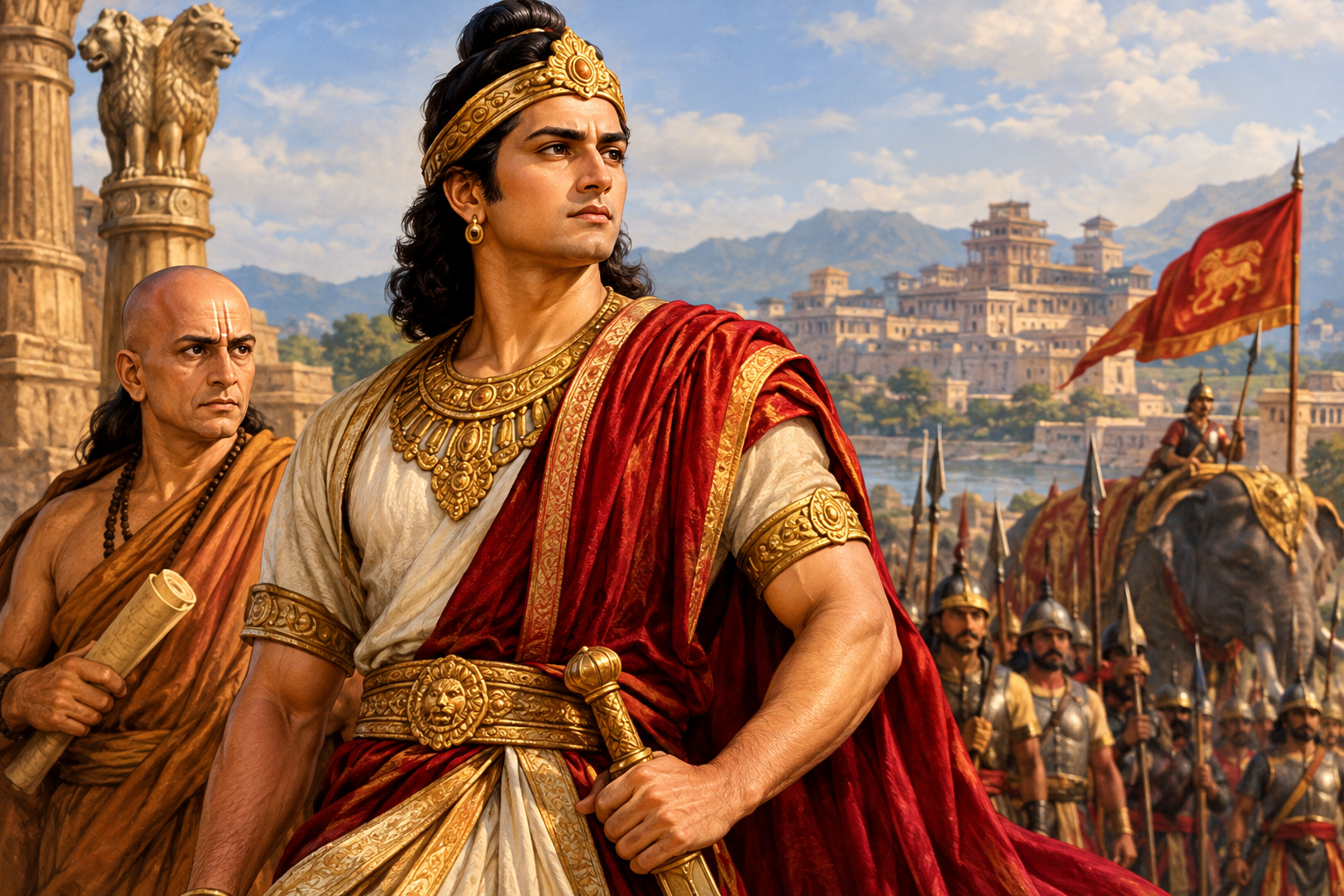
Chanakya, also known as Kautilya or Vishnugupta in traditional accounts, is closely associated with Chandragupta’s rise. The Arthashastra, a major text on statecraft, economic administration, diplomacy, and warfare, is traditionally attributed to Kautilya. However, scholars debate its composition and development, so it should not be treated as a simple record written entirely during Chandragupta’s reign.
The Chandragupta Maurya Empire developed a system of government that supported the collection of revenue, maintenance of an army, supervision of officials, and management of important territories. Pataliputra, near modern Patna, served as the imperial capital.
According to Jain tradition, Chandragupta later renounced royal life and travelled to southern India, where he is associated with the Jain community at Shravanabelagola. The details of this account come from religious traditions and should be distinguished from firmly established contemporary evidence.
Chandragupta’s reign laid the groundwork for the expansion and stability achieved by his successors.
3. Bindusara: The Second Mauryan Ruler
Bindusara succeeded Chandragupta Maurya and continued the work of maintaining and expanding the empire. Although fewer details about his reign survive than those of Chandragupta and Ashoka, he played an important role in preserving the authority of the Maurya dynasty.
Ancient sources associate Bindusara with the consolidation of Mauryan power in the Indian subcontinent. Some Greek accounts refer to diplomatic connections between the Mauryan court and Hellenistic rulers. These contacts suggest that the empire participated in wider political and commercial networks.
Bindusara’s reign also helped maintain the administrative structure inherited from his father. A large empire required the cooperation of provincial governors, officials, military commanders, and local authorities. Keeping these different regions connected was essential for collecting revenue and maintaining political order.
His importance lies in the continuity he provided between Chandragupta’s foundation of the empire and Ashoka’s later expansion and reforms.
4. Ashoka the Great and the Kalinga War
Ashoka is the best-known ruler of the Mauryan Empire. He became emperor in the third century BCE, traditionally dated to around 268 BCE, although the exact chronology depends on historical reconstruction. Under his rule, the empire reached a remarkable level of territorial expansion and political influence.
One of the most important events of his reign was the Kalinga War, generally dated to around 261 BCE. Kalinga occupied a region corresponding broadly to parts of present-day Odisha. Ashoka’s own Major Rock Edict XIII describes the suffering caused by the conquest, including deaths, deportations, and distress among the population.
The consequences of the war deeply influenced Ashoka’s public message. His inscriptions express regret over the violence and emphasise the importance of Dhamma, a broad ethical ideal involving compassion, restraint, respect for others, and responsible conduct.
Ashoka did not simply abandon government or all forms of political authority. Instead, his inscriptions show an effort to encourage moral behaviour while continuing to administer the empire. He supported the welfare of people and animals, appointed officials associated with Dhamma, and communicated his policies through inscriptions placed across different regions.
The Mauryan Empire under Ashoka became especially important in the history of Buddhism. Ashoka supported Buddhist institutions and helped spread Buddhist ideas, although the details of particular missions are preserved largely in later Buddhist traditions.
His inscriptions, written mainly in Prakrit using Brahmi script in much of the subcontinent, provide some of the most valuable direct evidence for the study of early Indian political history.
5. Administration of the Mauryan Empire
The administration of the Mauryan Empire was designed to govern a large territory with diverse populations and local traditions. The king stood at the centre of political authority, supported by ministers, officials, military commanders, and provincial administrators.
Pataliputra served as the capital and an important centre of government. The empire’s territories were administered through a combination of central authority, provincial governance, and local institutions. Important centres such as Taxila and Ujjain helped connect distant regions to the imperial administration.
The king’s officials were responsible for tasks such as revenue collection, law and order, trade regulation, and the supervision of public works. The exact structure and reach of administration varied across regions; historians do not assume that every part of the empire was controlled in the same way.
The Arthashastra discusses taxation, espionage, diplomacy, agriculture, trade, and the duties of officials. It is a valuable source for understanding ancient Indian ideas about governance, but its prescriptions should not automatically be taken as a complete description of daily administration under every Mauryan ruler.
Ashoka’s inscriptions provide more direct evidence of particular administrative practices. They mention officials such as the mahamatras and describe efforts to communicate royal instructions and promote public welfare.
The administration of the Maurya dynasty demonstrates the development of large-scale state organisation, while also showing the challenges of governing distant territories before modern transport and communication systems existed.
6. Economy, Agriculture and Trade
Agriculture was the foundation of the Mauryan economy. Most people depended on farming, and agricultural production supported towns, armies, officials, and royal institutions. Land revenue was an important source of state income.
Rivers such as the Ganges helped support agriculture, transport, and communication. The expansion of settlements and trade routes connected different regions, encouraging the movement of crops, raw materials, manufactured goods, and luxury products.
Craft production also played a significant role. Artisans produced textiles, metal objects, pottery, jewellery, and other goods for local consumption and wider trade. Markets and urban centres helped connect producers with merchants and consumers.
The empire’s position within broader networks also encouraged contacts with regions beyond the subcontinent. Relations with Hellenistic kingdoms created opportunities for diplomacy and exchange, although the scale and nature of particular commercial connections remain subjects of historical study.
A strong economy helped support the political and military power of the Mauryan state. At the same time, collecting revenue and maintaining officials across a large territory required substantial resources.
7. Art, Architecture and Ashokan Pillars
The Mauryan period made important contributions to Indian art and architecture. Among its best-known remains are the polished stone pillars erected under Ashoka. Many carry inscriptions that communicated the emperor’s ethical messages and policies.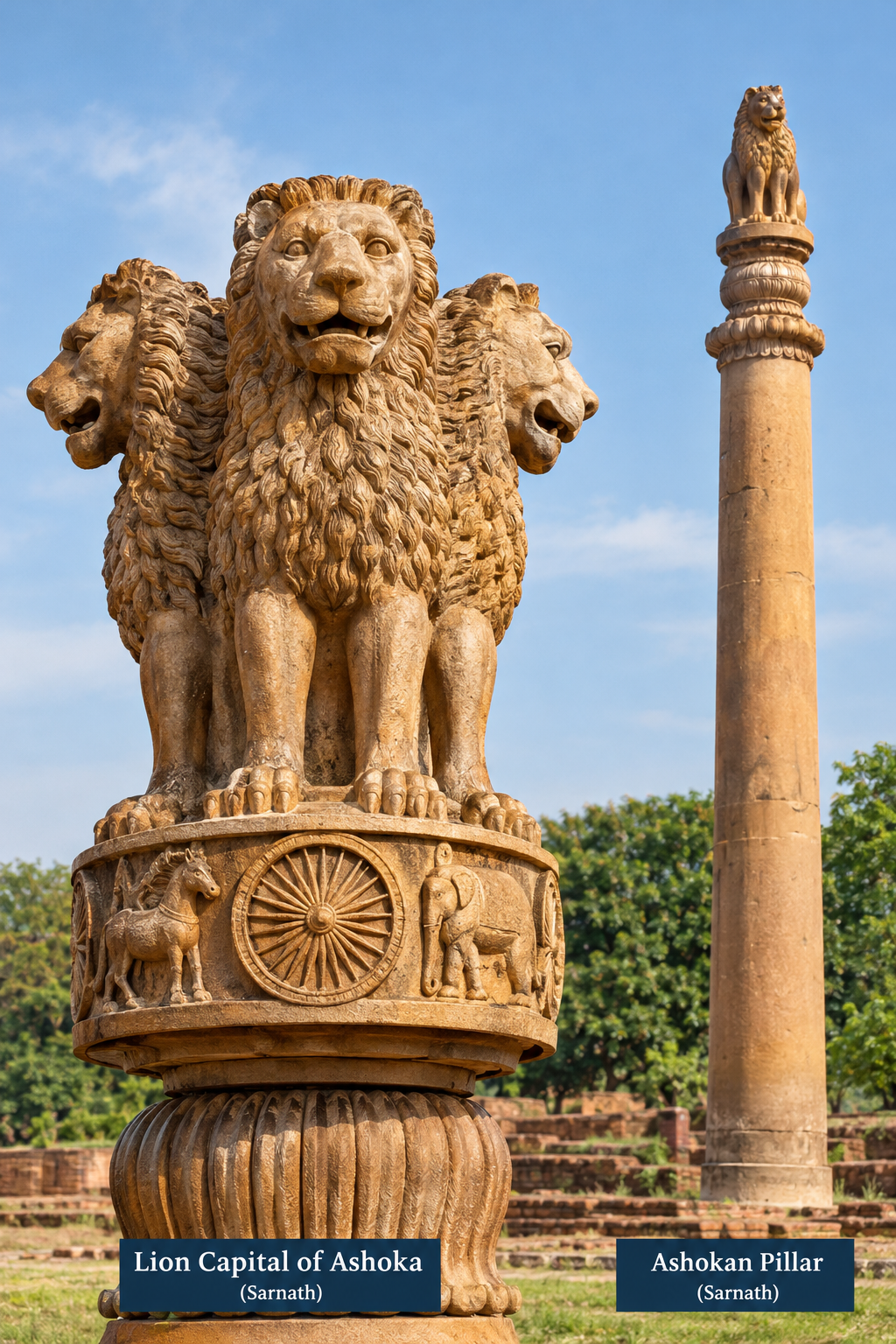
The Lion Capital of Sarnath is one of the most famous examples of Mauryan-period art. Its four lions stand above a circular abacus decorated with animals and a wheel motif. The capital reflects the technical skill of ancient stoneworkers and has become an enduring symbol of India’s historical heritage. The adapted Lion Capital was adopted as India’s national emblem after independence.
Ashoka also supported Buddhist monuments and institutions. The early development of stupas is associated with this period, although many surviving structures were enlarged or rebuilt in later centuries. The Great Stupa at Sanchi, for example, preserves evidence of a long history of construction and expansion.
The caves at Barabar, with their highly polished interiors, provide another important example of early Indian rock-cut architecture. Some were dedicated to the Ajivika community, demonstrating that religious patronage during the Mauryan period extended beyond Buddhism.
These monuments help historians understand the artistic achievements, political messages, and religious landscape of ancient India.
8. Religion and Dhamma Under Ashoka
Religion during the Mauryan period was diverse. Brahmanical traditions, Buddhism, Jainism, and other religious or philosophical communities existed within the wider cultural landscape.
Ashoka’s Dhamma was a public ethical programme rather than simply another name for Buddhism. His inscriptions promoted respect for parents and elders, kindness toward servants, restraint in behaviour, concern for living beings, and respect for different religious communities.
Ashoka encouraged religious tolerance and warned against praising one’s own tradition while unfairly criticising others. This message is particularly significant because it shows an imperial ruler addressing the challenge of maintaining social harmony across a diverse population.
Buddhism nevertheless occupied an important place in Ashoka’s personal religious life and royal patronage. Later Buddhist sources describe missions that carried Buddhist teachings to other regions. While these accounts are historically influential, the details of each mission should be assessed carefully against the available evidence.
The Maurya dynasty is therefore remembered not only for political expansion but also for its role in the history of religious patronage and ethical governance.
9. Decline of the Mauryan Empire
After Ashoka’s death, traditionally placed around 232 BCE, the empire gradually weakened. The exact sequence of later rulers and the speed of the decline remain subjects of historical debate.
Several factors may have contributed. Governing a vast territory required considerable revenue, military resources, and effective communication. Later rulers may have struggled to maintain the same level of political control. Regional powers and local authorities could also become more independent when central authority weakened.
However, historians should avoid explaining the decline through a single cause, such as Ashoka’s religious policies or the supposed disappearance of the army. The available evidence does not establish such simple explanations.
The final Mauryan ruler is generally identified as Brihadratha. According to later literary accounts, he was killed by his military commander Pushyamitra Shunga around 185 BCE, marking the end of the dynasty’s imperial rule in Magadha.
The end of Mauryan political unity did not mean that its cultural, administrative, and artistic influences disappeared. Many of these traditions continued to shape later Indian kingdoms.
10. Importance of the Mauryan Empire in Ancient History
The Mauryan period occupies a central place in the ancient history timeline of the Indian subcontinent. It demonstrates how a powerful state could unite extensive territories, maintain administrative institutions, support economic activity, and communicate royal policies through inscriptions.
Its importance can be understood through three major contributions. First, Chandragupta Maurya established an empire that transformed the political landscape of northern India. Second, the administrative and economic organisation of the state illustrates the development of early imperial government. Third, Ashoka’s inscriptions provide an unusually rich source of evidence about royal authority, public ethics, and religious tolerance.
The Mauryan legacy also survives through monuments, sculptures, inscriptions, and historical traditions. The Lion Capital of Sarnath remains a particularly visible link between ancient Indian history and modern India.
For students studying ancient India, the Mauryan period is essential for understanding state formation, Buddhism, early architecture, and the relationship between political power and society.
Conclusion
The Mauryan Empire was a major turning point in the history of ancient India. Founded by Chandragupta Maurya, strengthened under Bindusara, and transformed by Ashoka, it established a powerful imperial system that influenced politics, administration, religion, and art.
Although the empire eventually declined, its achievements continued to shape the subcontinent’s historical development. From the statecraft associated with Kautilya to Ashoka’s inscriptions and the Lion Capital of Sarnath, the Mauryan period offers valuable insights into India’s early past.
Understanding the Mauryan Empire helps readers place ancient Indian civilisation within a wider historical context and appreciate the enduring legacy of the Maurya dynasty.
Pingback: Ancient History Of India Timeline: A Complete Guide. - historyremindercom