

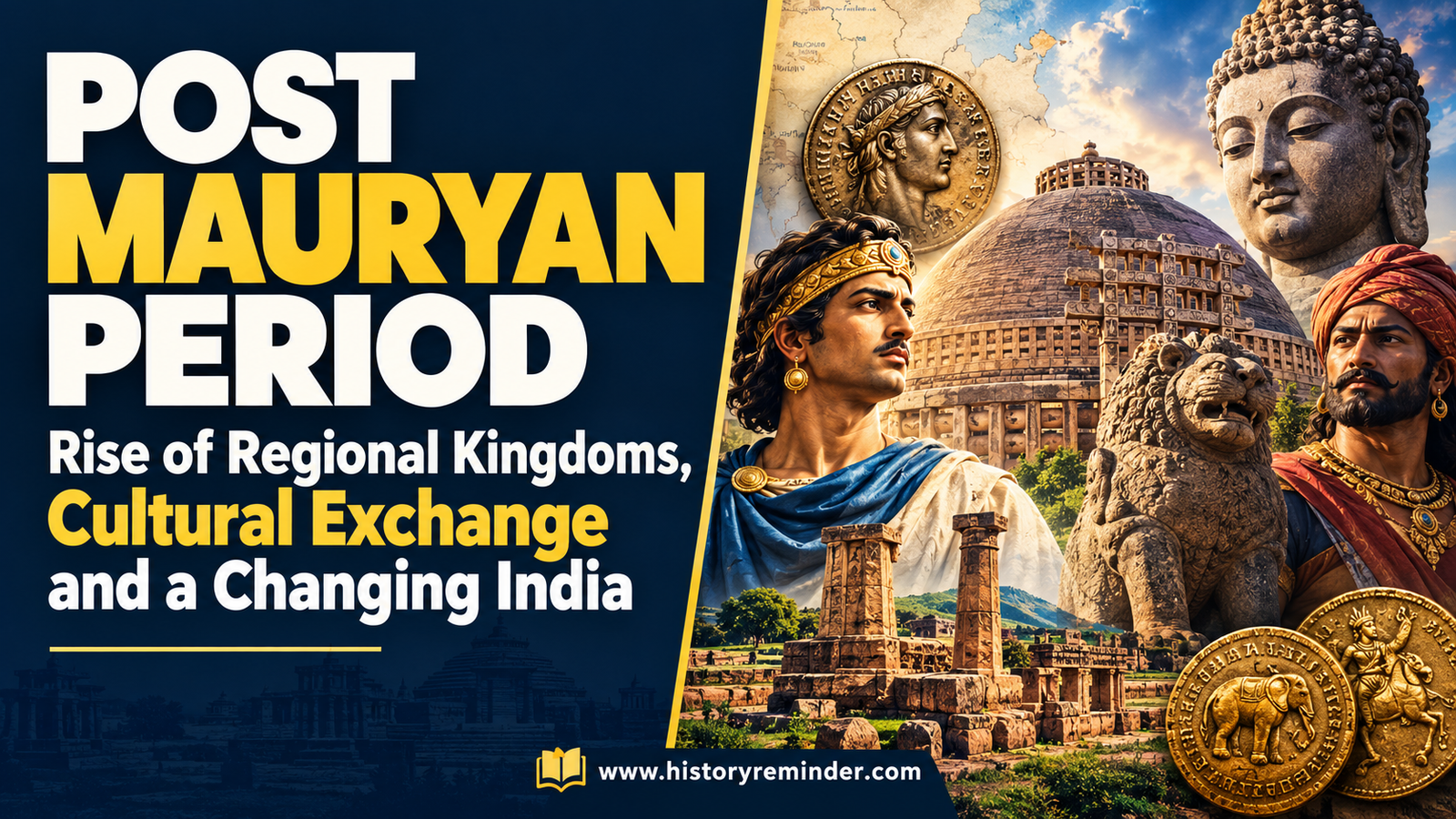
1. Political Condition After the Mauryan Empire
The Mauryan Empire reached its greatest extent under Emperor Ashoka. After his death in 232 BCE, the empire gradually weakened because of political instability, administrative difficulties, and the challenges of controlling a vast territory. Around 185 BCE, the last Mauryan ruler, Brihadratha, was killed by his military commander Pushyamitra Shunga, who established the Shunga dynasty.
The Post Mauryan Period was marked by political fragmentation. Instead of one large empire controlling most of the subcontinent, several kingdoms emerged in northern, central, and southern India. Some rulers controlled important agricultural regions, while others gained power through trade routes and military expansion.
Despite the decline of a central imperial authority, political and cultural life continued to flourish. Regional kingdoms developed their own administrative systems, issued coins, supported religious institutions, and established connections with neighbouring territories.
2. Major Dynasties of the Post Mauryan Period
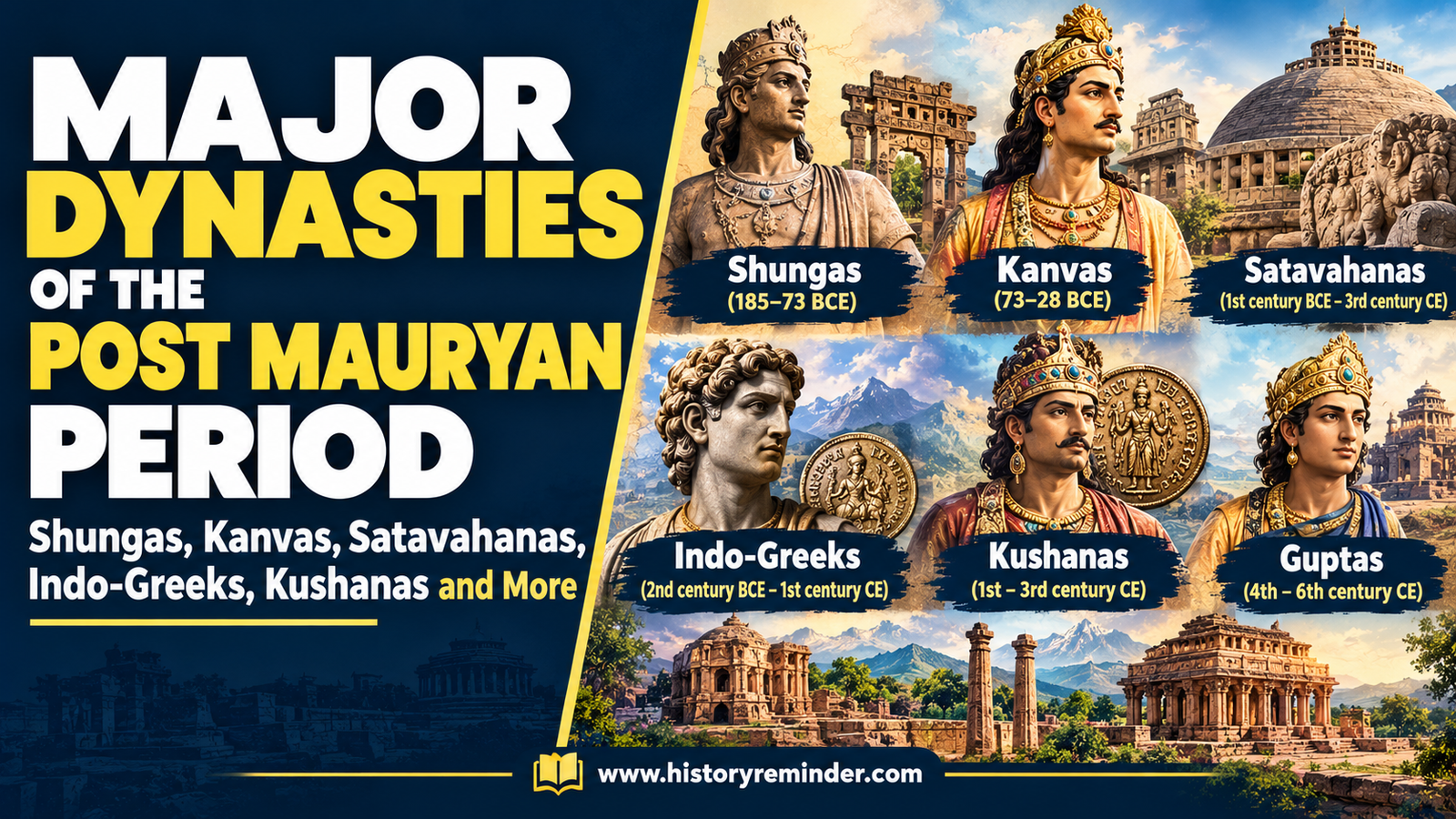
A. Shunga Dynasty (c. 185–73 BCE)
The Shunga dynasty was founded by Pushyamitra Shunga after the fall of the Mauryan Empire. Its power was mainly concentrated in parts of northern and central India. Pushyamitra strengthened the kingdom and is traditionally associated with the performance of Vedic sacrifices, including the Ashvamedha.
The Shunga period is also associated with developments in Buddhist art and architecture. Important Buddhist sites, including Bharhut and Sanchi, received artistic additions or embellishments during this broad period. The history of these monuments shows that religious and artistic traditions continued to evolve even as political power changed hands.
B. Kanva Dynasty (c. 73–28 BCE)
The Kanva dynasty succeeded the Shungas in Magadha. It was founded by Vasudeva Kanva, who is traditionally described as having overthrown the last Shunga ruler. The Kanvas ruled for a relatively short period and exercised limited political influence compared with the Mauryan Empire.
The Kanva dynasty is important because it represents the continuing political changes in northern India after the decline of the Mauryas. Its eventual fall created further opportunities for regional powers to expand their influence.
C. Indo-Greek Kingdoms
Indo-Greek rulers controlled parts of northwestern India following the expansion of Greek political power in the regions beyond the Hindu Kush. Their presence encouraged interactions between Indian and Hellenistic cultures. One of the best-known Indo-Greek kings was Menander I, also called Milinda.
Menander is associated with the Buddhist text Milindapanha, which presents a philosophical dialogue between King Milinda and the Buddhist monk Nagasena. Although the text developed through a complex literary tradition, it is an important source for understanding the intellectual exchanges of the period.
Indo-Greek rulers also issued coins that combined Greek inscriptions and artistic features with Indian symbols and, in some cases, local languages. Their coinage provides valuable evidence about political authority, economic activity, and cultural contact in ancient northwestern India.
D. Shaka or Indo-Scythian Rulers
The Shakas, also known as Indo-Scythians, entered northwestern India from Central Asia and gradually established kingdoms in different regions. Some Shaka rulers later controlled areas of western India, where they played an important role in regional politics and commerce.
One prominent ruler was Rudradaman I of the Western Kshatrapas, who ruled during the second century CE. His Junagadh inscription, written in Sanskrit, is an important historical record. It describes his achievements and the repair of the Sudarshana Lake, highlighting the importance of public works and royal authority.
E. Satavahana Dynasty
The Satavahanas became a major political power in the Deccan. Their kingdom played an important role in connecting the inland regions of India with western coastal ports. The dynasty’s chronology and territorial extent remain subjects of historical discussion, but its importance in the Deccan is well established.
Gautamiputra Satakarni was one of the best-known Satavahana rulers. An inscription issued by his mother, Gautami Balashri, praises his achievements and military successes. The Satavahanas supported trade and religious establishments, including Buddhist monastic sites and rock-cut monuments.
F. Kushana Dynasty
The Kushanas emerged from Central Asian groups and established a powerful kingdom across parts of Central Asia and northern India. Their empire reached a high point under Kanishka, who is generally placed in the second century CE, although the precise date of his accession remains debated.
The Kushanas encouraged long-distance trade and cultural interaction across their territories. Their rule helped connect Indian regions with Central Asia and the Silk Road networks. Kushana coins featured a wide range of deities, reflecting the religious diversity of the empire.
The Kushana period was also important for Buddhist art. Gandhara and Mathura became major centres of artistic production, with distinctive approaches to representing the Buddha and other religious figures.
3. Economic Development and Trade
Trade was one of the major features of the Post Mauryan Period. Merchants transported textiles, spices, beads, precious stones, ivory products, and other goods between different parts of India and overseas markets. Indian traders maintained commercial connections with Central Asia, the Roman world, and regions around the Indian Ocean.
Both inland and maritime routes contributed to economic growth. Important ports on the western and eastern coasts connected Indian merchants with international trading networks. Inland trade routes linked urban centres, agricultural regions, craft-production areas, and religious establishments.
Coins made from metals such as copper, silver, and gold provide evidence of economic transactions and royal authority. Merchant associations, commonly described as guilds, also played a role in organising crafts and trade. Inscriptions from Buddhist sites record donations by merchants, artisans, and other supporters, demonstrating the close relationship between commerce and religious institutions.
4. Religious Developments
Religious life became increasingly diverse during the Post Mauryan Period. Buddhism, Jainism, and Brahmanical traditions continued to develop, attracting support from different rulers, merchants, and communities. Religious practices varied across regions, and political changes did not produce a single uniform religious pattern.
Buddhism benefited from donations to monasteries, stupas, and other religious monuments. Buddhist institutions also served as centres of learning and community activity. The spread of Buddhist traditions along trade routes helped connect India with Central Asia and other parts of Asia.
Brahmanical traditions also developed through religious literature, ritual practices, and the growing importance of different deities. The worship of Vishnu, Shiva, and other divine figures gradually became influential in several regions. Jain communities likewise maintained religious institutions and traditions of learning.
The interaction between merchants, monks, rulers, and local communities helped religious ideas travel across geographical and cultural boundaries.
5. Art and Architecture
The Post Mauryan Period witnessed significant developments in sculpture, architecture, and the visual representation of religious ideas. Buddhist monuments at Sanchi and Bharhut feature decorated railings, gateways, and narrative reliefs depicting events associated with the Buddha and Buddhist traditions.
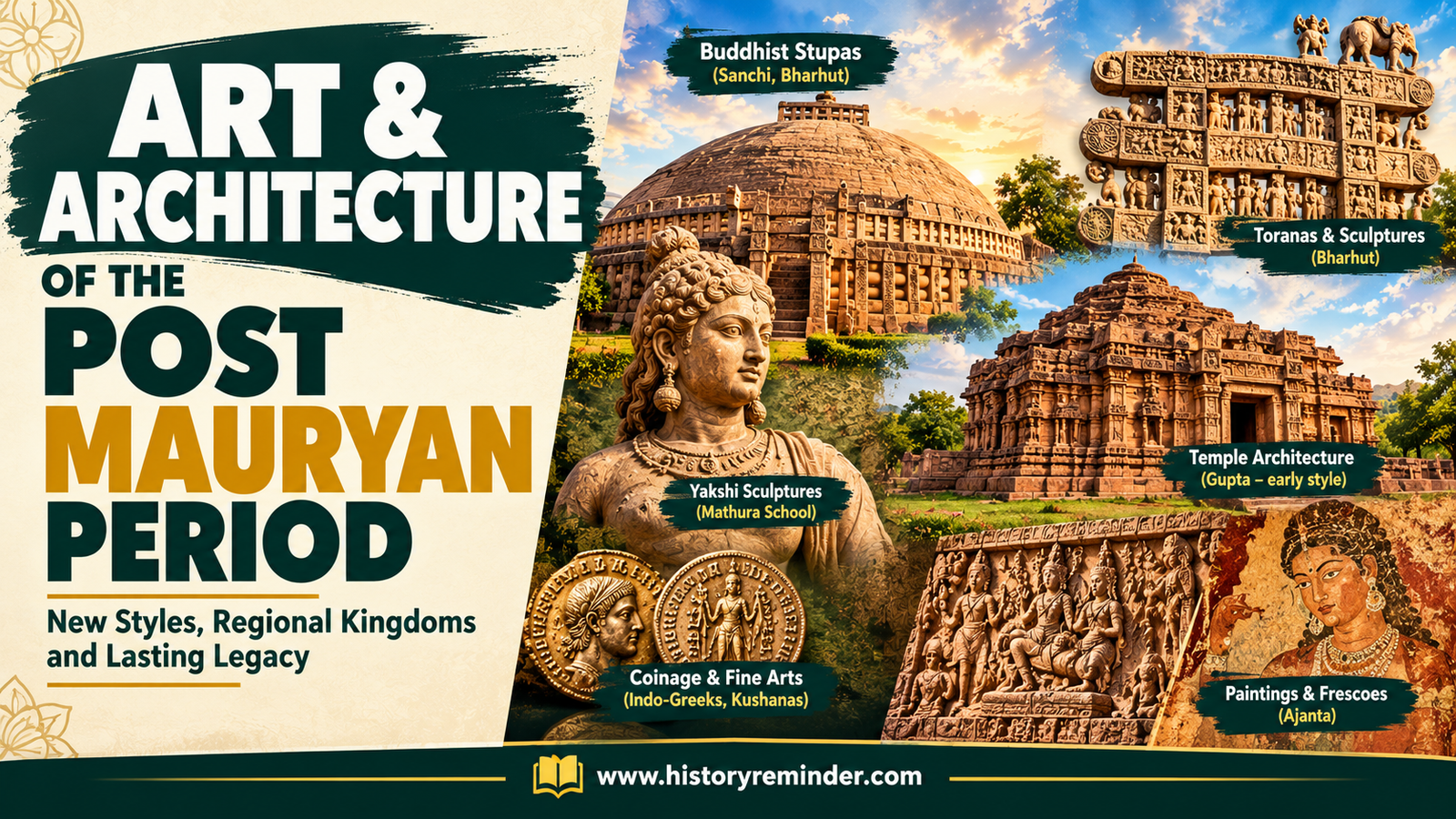
Two major artistic traditions developed during this period: Gandhara art and Mathura art. Gandhara art, produced in areas of present-day Pakistan and Afghanistan, often displayed Hellenistic and Central Asian influences. Artists frequently represented the Buddha in human form, using drapery and facial features associated with regional artistic conventions.
Mathura art developed in northern India and used local artistic traditions. Sculptors worked with red sandstone and produced images of the Buddha, Jain figures, and Brahmanical deities. The two traditions demonstrate that ancient Indian art developed through both local innovation and cultural interaction.
Rock-cut caves, stupas, and monasteries also expanded in importance. Sites such as Karle and Bhaja in the western Deccan illustrate the relationship between religious architecture, merchant donations, and trade routes.
6. Literature, Language, and Cultural Exchange
Literary and linguistic traditions continued to develop during the Post Mauryan Period. Sanskrit became increasingly prominent in royal inscriptions, while Prakrit languages remained important in inscriptions and religious contexts. The languages used by rulers and communities varied according to region and purpose.
The Junagadh inscription of Rudradaman I is particularly important because it is an early major royal inscription composed in polished Sanskrit prose. It illustrates the growing use of Sanskrit for communicating royal achievements and political authority.
Cultural exchange also influenced coin designs, artistic styles, religious practices, and political ideas. Contact between Indian kingdoms and Central Asian or Hellenistic societies encouraged the movement of people, objects, and knowledge across regions.
7. Historical Significance of the Post Mauryan Period
The Post Mauryan Period was not simply an era of decline following the Mauryan Empire. It was a period of regional political growth, expanding trade networks, artistic innovation, and religious diversity. Different dynasties shaped the development of their respective regions while maintaining connections with wider commercial and cultural networks.
The Indo-Greek rulers contributed to cultural and numismatic exchanges, the Shakas strengthened regional kingdoms, the Satavahanas supported Deccan trade, and the Kushanas connected northern India with Central Asia. Meanwhile, Buddhist, Jain, and Brahmanical traditions continued to evolve.
These developments prepared the ground for later political and cultural changes in ancient India. Studying this period helps explain how Indian society remained dynamic even after the end of Mauryan imperial rule.
Conclusion
The Post Mauryan Period was a transformative phase in ancient Indian history. Although the Mauryan Empire had disappeared, political activity, commerce, religion, and artistic creativity continued to flourish under several regional and transregional powers. The Shungas, Kanvas, Indo-Greeks, Shakas, Satavahanas, and Kushanas each contributed to this changing historical landscape.
For students preparing for ancient Indian history examinations, understanding the Post Mauryan Period is essential for connecting the Mauryan Empire with the rise of later kingdoms. Its political developments, inscriptions, coinage, trade routes, and artistic traditions provide valuable evidence for understanding India’s cultural and historical evolution.
Pingback: Ancient History Of India Timeline: A Complete Guide. - historyremindercom