

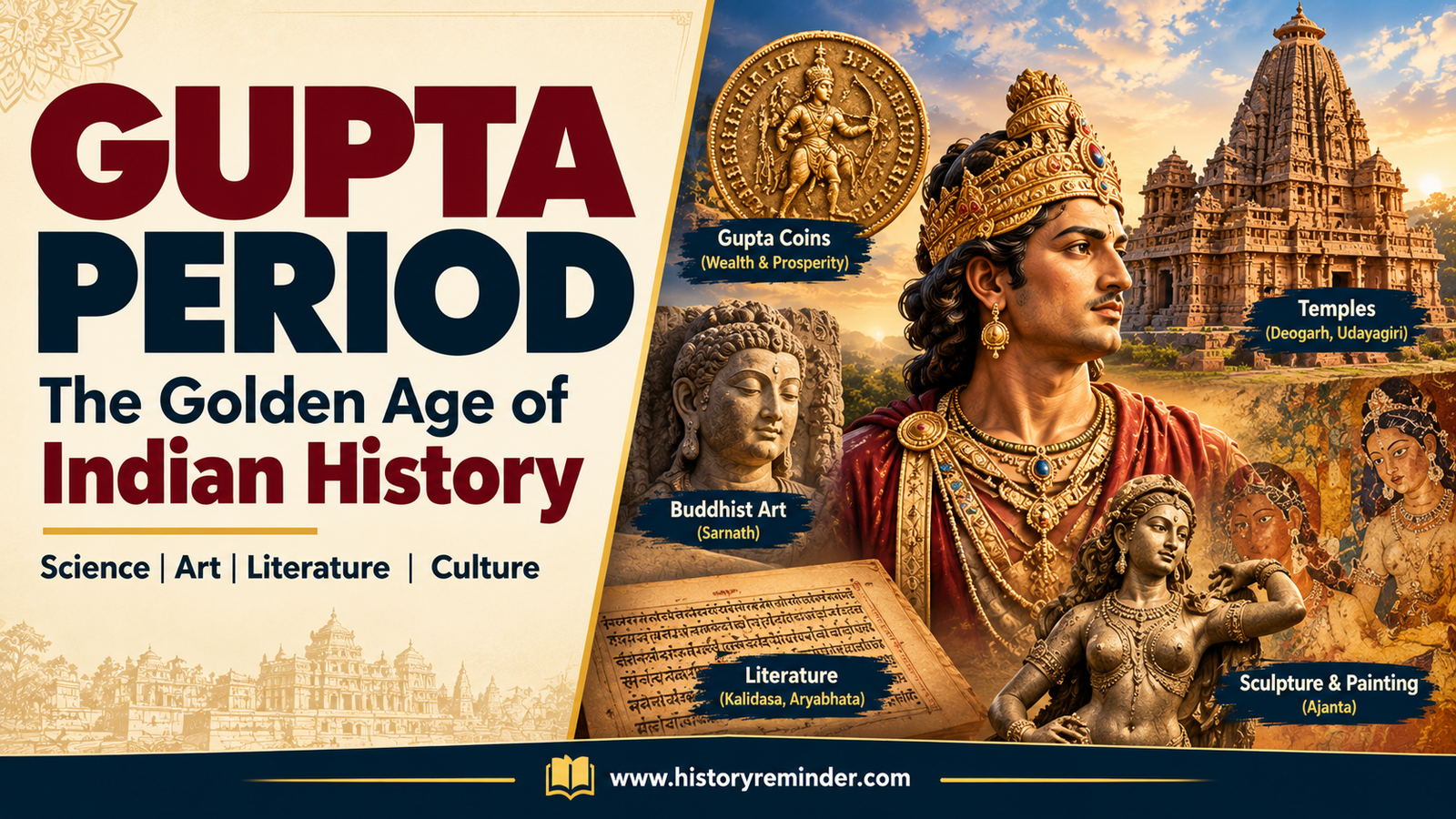
The Gupta Era is particularly important for understanding the development of Indian civilization after the Mauryan and Post-Mauryan periods. Gupta rulers expanded their political influence, maintained trade networks, issued gold coins, and supported religious and cultural institutions. Their achievements influenced later Indian kingdoms and contributed to the development of classical Indian traditions.
1. Rise and Establishment of the Gupta Empire
The Gupta dynasty rose to prominence in northern India during the early fourth century CE. The early rulers, Sri Gupta and Ghatotkacha, preceded Chandragupta I, who played a major role in establishing the dynasty as a significant political power. The exact territorial extent of the early Gupta kingdom remains uncertain.
Chandragupta I came to power around 319–320 CE, although the precise chronology is debated. His marriage to Kumaradevi, a princess of the Licchavi family, is considered an important political alliance. The dynasty’s inscriptions and coins suggest that this connection strengthened its prestige and influence.
The term Gupta Era is also associated with a calendar system traditionally dated from 319–320 CE. This era was used in inscriptions and other historical records, helping historians establish the chronology of events during the period. It should not be confused with the entire duration of Gupta political rule.
2. Important Rulers of the Gupta Period
A. Chandragupta I (c. 319–335 CE)
Chandragupta I is generally regarded as one of the founders of Gupta imperial power. His marriage alliance with Kumaradevi helped strengthen the dynasty’s political position. He adopted the title Maharajadhiraja, meaning “great king of kings,” which reflected his elevated status.
During his reign, the Gupta kingdom expanded its influence in parts of northern India. His achievements created the foundation for the later expansion of the empire under his son, Samudragupta.
B. Samudragupta (c. mid-fourth century CE)
Samudragupta was one of the most successful rulers of the Gupta dynasty. His military campaigns are described in the Allahabad Pillar inscription, also known as the Prayaga Prashasti. The inscription was composed by Harisena, an important court official.
The inscription describes Samudragupta’s campaigns against rulers in northern India and his expeditions into the southern regions. Rather than directly annexing every conquered territory, he followed different policies toward different rulers. Some kingdoms were incorporated into the empire, while others retained local authority after accepting his supremacy.
Samudragupta was also associated with cultural activities and is known for gold coins depicting him playing a musical instrument. His military achievements and political strategies significantly increased Gupta influence.
C. Chandragupta II (c. late fourth to early fifth century CE)
Chandragupta II, also known as Vikramaditya in later traditions, presided over a period of considerable Gupta influence. He is associated with the defeat or absorption of Western Kshatrapa power in western India, which improved the empire’s access to important commercial regions.
The expansion into western India strengthened the Gupta position in trade and commerce. Silver coins issued in western regions reflect the importance of adapting royal coinage to established local monetary traditions.
The Chinese Buddhist pilgrim Faxian visited India during Chandragupta II’s reign. His travel account provides information about Buddhist communities, social conditions, and religious life. However, his observations were shaped by his particular interests and should not be treated as a complete description of Indian society.
D. Kumaragupta I and Skandagupta
Kumaragupta I maintained much of the empire inherited from his predecessors. His reign is associated with continued political stability and the issuance of numerous coins. Later traditions connect him with the establishment of educational institutions, although specific claims require careful examination of the evidence.
Skandagupta, who ruled during the fifth century CE, faced serious challenges, including conflicts with the Hunas and other groups. Inscriptions describe military successes, but the costs of warfare and increasing political pressures weakened the empire’s long-term stability.
3. Administration During the Gupta Era
The administration of the Gupta Period combined royal authority with regional and local institutions. The king occupied the highest political position and was responsible for military leadership, justice, and the protection of the kingdom. Royal titles and inscriptions presented rulers as powerful leaders who maintained order and supported religious and cultural activities.
The empire was divided into administrative units. Provinces were commonly known as bhuktis, while districts were often called vishayas. Officials helped manage revenue collection, administration, and public affairs. Local bodies, merchants, and landholders also played roles in regional administration.
Land grants became increasingly important during this period. Rulers donated land to Brahmanas and religious institutions, sometimes granting specific rights over revenue or local administration. These grants helped spread agricultural settlements and religious traditions, but they could also transfer authority and economic resources away from direct royal control.
Gupta administration was not equally centralized everywhere. Some regions were governed directly, while others maintained substantial local autonomy. This flexible system helped the empire govern diverse territories but also made it dependent on the loyalty of regional powers.
4. Economy, Agriculture, and Trade
The economy during the Gupta Era depended heavily on agriculture. Farmers produced crops that supported towns, markets, and the royal administration. Land revenue was an important source of income for rulers, while land grants influenced the organisation of agricultural production in different regions.
Craft production also contributed to economic activity. Artisans manufactured textiles, metal objects, pottery, jewellery, and other goods. Merchant associations and craft guilds helped organise production and trade. Inscriptions provide evidence of donations and financial arrangements involving merchants and religious institutions.
Gold coins were a notable feature of Gupta monetary history. Many coins displayed rulers performing military, religious, or cultural activities. These coins provide valuable information about royal titles, political authority, artistic styles, and economic exchange.
Trade continued within India and with foreign regions, although its scale varied over time and between areas. The empire’s connections with western India offered access to important commercial routes. Historians continue to debate changes in long-distance trade, urban life, and monetary circulation during the later Gupta centuries.
5. Science and Mathematics
One of the most celebrated features of the Gupta Era was the development of mathematical and astronomical knowledge. Indian scholars made important contributions to numerical methods, calculations, planetary studies, and mathematical reasoning. These achievements formed part of a longer intellectual tradition that continued beyond Gupta rule.
Aryabhata, born in 476 CE, was a major mathematician and astronomer. His work, the Aryabhatiya, discussed arithmetic, algebra, trigonometry, and astronomy. He explained that the apparent daily movement of the stars was connected to the Earth’s rotation and offered a mathematical explanation for eclipses.
The decimal place-value system and the development of zero were major achievements in the history of mathematics, but they evolved over time rather than appearing in a single moment. The Gupta period belongs to this broader history of mathematical development.
Scholars also studied medicine, astronomy, and other fields of knowledge. Their works were transmitted, interpreted, and developed by later generations, helping Indian scientific traditions influence scholarship across Asia and beyond.
6. Literature and Education
Sanskrit literature flourished during the Gupta Period. Courtly poetry, drama, religious texts, and scholarly works became important parts of elite cultural life. Sanskrit was widely used in royal inscriptions, while Prakrit languages and other regional linguistic traditions continued to exist.
Kalidasa is among the most celebrated Sanskrit literary figures associated with the Gupta age, although the exact dates of his life remain uncertain. His works include Abhijnanashakuntalam, Meghaduta, and Raghuvamsha. His poetry and drama are known for their descriptions of nature, human emotions, royal life, and social relationships.
Other important intellectual traditions developed in grammar, philosophy, religious studies, and medicine. Buddhist and Brahmanical centres of learning attracted students and scholars. Education, however, was not universally accessible, and opportunities differed according to social position, gender, resources, and location.
7. Religion and Society
Religion played a significant role in the Gupta Era. Many Gupta rulers supported Brahmanical traditions, especially forms of Vaishnavism, while Shaivism and other religious practices also developed. Royal inscriptions and coins sometimes connected kingship with religious beliefs and divine protection.
Temples dedicated to Hindu deities became increasingly important, and early structural temples provide evidence of developments in religious architecture. The Dashavatara Temple at Deogarh, generally dated to the Gupta period, is an important example of early Hindu temple design.
Buddhism and Jainism also continued to receive support from different communities and patrons. Buddhist monasteries remained centres of religious learning, while Buddhist art and literature developed in several regions. The relationship between rulers and religious institutions varied, and it would be inaccurate to assume that one tradition completely replaced the others.
Social life remained influenced by caste distinctions, family structures, and occupational differences. Religious and legal texts provide information about social ideals, but they do not necessarily represent the experiences of every community. Understanding the period therefore requires comparing literary accounts with inscriptions, coins, and archaeological evidence.
8. Art and Architecture
Art and architecture reached important stages of development during the Gupta Period. Sculptors created refined images of the Buddha, Hindu deities, and Jain figures. Gupta artistic styles are often associated with balanced proportions, calm expressions, and carefully modelled forms.
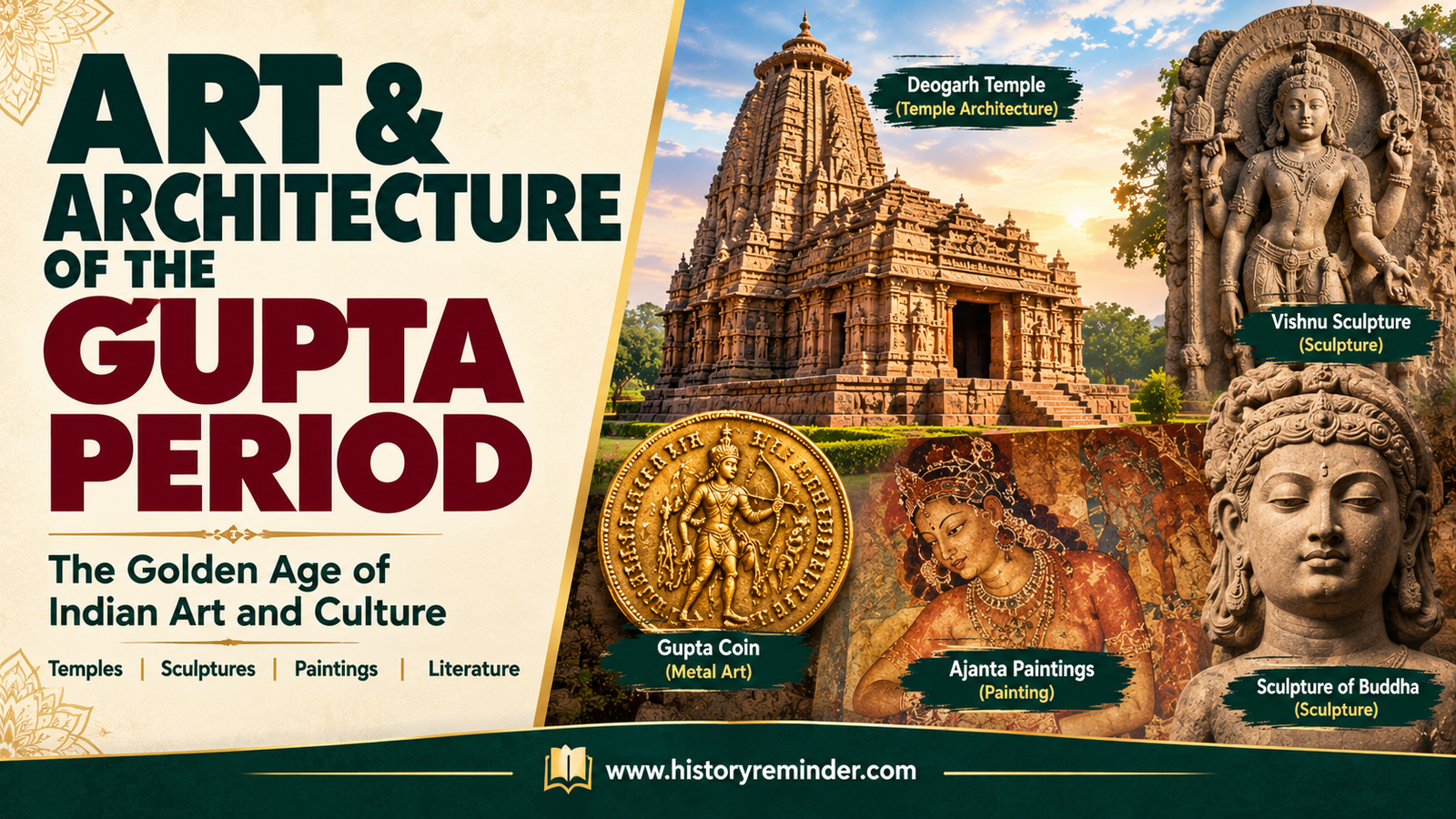
The Buddhist sculptures of Sarnath are particularly well known for their smooth surfaces and peaceful expressions. These works influenced later Buddhist artistic traditions in different parts of Asia.
Temple architecture also developed during this period. The Dashavatara Temple at Deogarh and other surviving structures illustrate the growing importance of permanent temples dedicated to Hindu deities. Although relatively few early Gupta buildings survive in their original condition, archaeological remains reveal important changes in religious architecture.
Painting traditions also flourished in parts of India. The Ajanta cave paintings, created across several phases, include important examples from the broader period of Gupta cultural influence. Their colours, figures, and narrative scenes provide valuable evidence of artistic skill and religious life.
9. Decline of the Gupta Empire
The decline of the Gupta Empire was gradual rather than the result of a single event. During the fifth and sixth centuries CE, the dynasty faced external invasions, internal political challenges, and the growing independence of regional rulers.
Huna incursions placed pressure on parts of northern India. Skandagupta resisted some of these threats, but later rulers struggled to maintain the empire’s earlier strength. Disputes over succession and the expansion of regional powers further weakened central authority.
Economic and administrative changes may also have contributed to the decline, although historians debate their relative importance. Land grants, regional autonomy, and the changing pattern of trade affected different areas in different ways.
By the sixth century CE, the Gupta Empire had lost much of its former political influence. However, the end of Gupta imperial power did not mean the end of Indian cultural development. Regional kingdoms continued to support literature, religion, art, and architecture.
10. Historical Significance of the Gupta Era
The Gupta Era remains an important subject for understanding ancient Indian history because it witnessed major developments in political organisation, literature, mathematics, astronomy, and artistic traditions. Its inscriptions, coins, and archaeological remains help historians reconstruct the achievements and limitations of the empire.
The period also demonstrates that cultural progress can occur alongside social inequalities and regional differences. While royal courts and religious institutions supported important intellectual achievements, access to education, wealth, and political power remained uneven.
For students preparing for competitive examinations, the Gupta dynasty is especially important for topics such as Samudragupta’s Allahabad Pillar inscription, Chandragupta II, Aryabhata, Kalidasa, Gupta coinage, temple architecture, and the Huna invasions.
Conclusion
The Gupta Period was a formative chapter in ancient Indian history. Its rulers expanded political power, while scholars, artists, and religious communities contributed to mathematics, astronomy, literature, sculpture, and architecture. These achievements explain why the period is frequently called the Golden Age of ancient India, although this description should be understood with attention to regional and social differences.
The Gupta Era left a lasting influence on later Indian kingdoms and intellectual traditions. By studying its rulers, administration, economy, religion, and cultural achievements, readers can better understand the complexity and diversity of ancient Indian civilization.
Pingback: Ancient History Of India Timeline: A Complete Guide. - historyremindercom